ExhibitionDecember 8, 2011
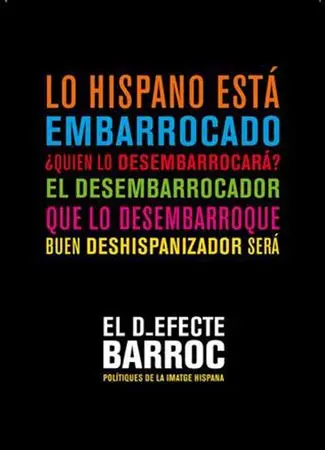
The Borroque D_Effect: Politics of the Hispanic Image
On November 22nd in the city of Quito (Ecuador), the Centro de Arte Contemporáneo (CAC) inaugurated the collective exhibition entitled The Borroque D_Effect: Politics of the Hispanic Image. The exhibition will remain open to the public until March 4, 2012. The collective effort is the result of a 6 year-long research that began in 2011 and lasted until February of 2011. The exhibition is sponsored by the Fundación Museos de la Ciudad, the Embassy of Spain in Ecuador, the Socieded Estatal de Acción Cultural, and the Centro de Cultura Contemporánea in Barcelona. Originally curated by Spanish curators Jorge Luis Marzo and Teresa Badia-and currently curated by the team at the Centro de Arte Contemporáneo in Quito-the exhibition The Borroque D_Effect: Politics of the Hispanic Image combines the efforts of a group of collaborators that include the following artists: David Hoffos, Nuria Arias, Edgar Clement, Pepe Quintero, Pedro G. Romero, David Blanco, Claudia Llosa, Fernando Ruiz de Vergara, and Miguel Calderón, among others. Ecuador has contributed with artists and researchers Andrés Barriga, Miguel Alvear, Pedro Cagigal, and Susan Rocha. The artists relied on the use of contemporary mixed media, such as video, installation, video-installation, and performance. Here, mixed media used to question and to analyze that which appears to be a collective imaginary that unifies the Latin American identity with the Spanish one: "hispanicity". But, what does "hispanicity" mean exactly? Which factors have allowed this myth to last and to be disseminated throughout most of Latin America? And most importantly, what role has art and aesthetics played in the debate surrounding it, and in which ways have the visual disciplines contributed or complicated such debate. Is it that that which today we regard as "Hispanic" represents a culture that survives through architectural structures or through the paraphernalia we regard as characteristics of the baroque? Or furthermore, is it possible that the strongest mode to convey this "Hispanic" imaginary is through the baroque that surrounds us? According to the Public News Agency in Quito "Spain, Mexico, Peru, Chile and Ecuador-countries that are highly diverse and culturally and socio-politically very complex-share certain characteristics in the ways they have managed their memory and have contributed to counteract, by example, the myth of Hispanic homogeneity." The Borroque D_Effect: Politics of the Hispanic Image represents one of the examples of this countercurrent. It is an exhibition focused on the fragmentation and confrontation of the tacit collective memory in Latin America; an exhibition determined to confront the responsibilities of the visual arts and to address the manner in which such artistic manifestations relate to power.