InstallationOctober 8, 2021· By Sylvia Werneck
Two new Installations at Inhotim
At the end of August, two installations were opened that integrated the research line Território Específico, developed by the Curators of the Institute for 2021 - 2022. The idea is to think about the relationship between art and the environment that affects it and is affected by it.
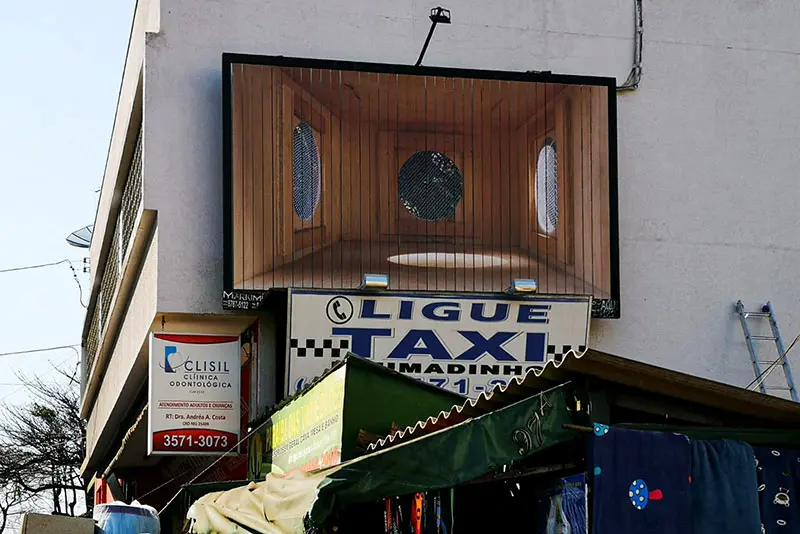
Propaganda, 2021, by Lucia Koch, explores the broad senses of the word that can refer to both the market and ideologies. Perspective ultimately alters the perception of things. Photographs of the inside of empty packaging made during the confinement imposed by the pandemic (objects that became the link of contact with the world out there) challenge the gaze by deciphering strange "uninhabited architectures"— the scale of the images is the size of the outdoors (street billboards) —bringing the viewer closer to the dimensions of the absent content. There is something playful in the attempt to decipher what the image portrays. It is clear that the relationship with the installations is in the field of aesthetic and conceptual delectation because it is within the limits of the Inhotim, which certifies their status as artworks. Outside the walls, the images were inserted on previously existing "outdoors" in the city of Brumadihno. In this other context, "framed" by typical structures of the consumer world, without selling anything, they are perhaps opportunities for pause, estrangement, and reflection.
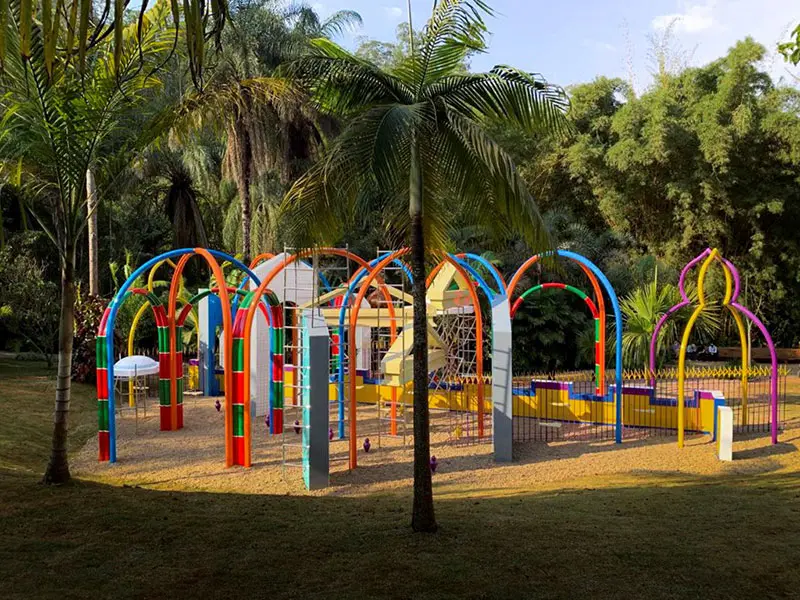
Rommulo Vieira Conceição challenges the viewer with promises that will not be kept. At first glance, "Physical space can be an abstract, complex place under construction" (2021) resembles a playground. They are structures of polished, colorful, and shiny industrial materials that awaken the will to walk through the created spaces. Our repertoire of images identifies elements of school, religious, recreational environments - spaces intended for gathering people and sharing knowledge and affection. It is necessary to stop and observe the details of the composition calmly to perceive the paradoxes of the whole. The work is not interactive, and it is not allowed to be touch. The floor is covered with gravel, an inadequate material to sit on, often used in parking lots. Steps or walls separate the seemingly inviting rooms. Steep staircases come to nothing, and gables of Greco-Roman inspiration, common in today's evangelical temples, are supported by metal structures that obstruct the passage. The complementary colors seen throughout seem to illustrate conflicting concepts - security/imprisonment, education/conditioning, faith/control.
According to the artist, one of the most fundamental concepts of the work is the criticism of the proliferation of fundamentalist evangelical currents, whose conservative ideology has greatly impacted the direction of national politics. In one of the corners of the installation, a row of structures reminiscent of the tripartite spear of Exu (Orixá, who acts as guardian and messenger between the earthly and spiritual worlds) is notorious. Given the intolerance suffered by Afro religions, the advanced proposal of these symbols seems to evoke hope, but above all, resistance.
Lucia Koch's work will remain on display for a year. Rommulo Vieira Conceição's is a permanent installation.
Note
The Instituto Inhotim is one of the most important contemporary art collections in Brazil, considered one of the largest open-air museums in the world. It is in Brumadinho, 60 kilometers from Belo Horizonte, in the state of Minas Gerais.
Propaganda, 2021, by Lucia Koch, explores the broad senses of the word that can refer to both the market and ideologies. Perspective ultimately alters the perception of things. Photographs of the inside of empty packaging made during the confinement imposed by the pandemic (objects that became the link of contact with the world out there) challenge the gaze by deciphering strange "uninhabited architectures"— the scale of the images is the size of the outdoors (street billboards) —bringing the viewer closer to the dimensions of the absent content. There is something playful in the attempt to decipher what the image portrays. It is clear that the relationship with the installations is in the field of aesthetic and conceptual delectation because it is within the limits of the Inhotim, which certifies their status as artworks. Outside the walls, the images were inserted on previously existing "outdoors" in the city of Brumadihno. In this other context, "framed" by typical structures of the consumer world, without selling anything, they are perhaps opportunities for pause, estrangement, and reflection.
Rommulo Vieira Conceição challenges the viewer with promises that will not be kept. At first glance, "Physical space can be an abstract, complex place under construction" (2021) resembles a playground. They are structures of polished, colorful, and shiny industrial materials that awaken the will to walk through the created spaces. Our repertoire of images identifies elements of school, religious, recreational environments - spaces intended for gathering people and sharing knowledge and affection. It is necessary to stop and observe the details of the composition calmly to perceive the paradoxes of the whole. The work is not interactive, and it is not allowed to be touch. The floor is covered with gravel, an inadequate material to sit on, often used in parking lots. Steps or walls separate the seemingly inviting rooms. Steep staircases come to nothing, and gables of Greco-Roman inspiration, common in today's evangelical temples, are supported by metal structures that obstruct the passage. The complementary colors seen throughout seem to illustrate conflicting concepts - security/imprisonment, education/conditioning, faith/control.
According to the artist, one of the most fundamental concepts of the work is the criticism of the proliferation of fundamentalist evangelical currents, whose conservative ideology has greatly impacted the direction of national politics. In one of the corners of the installation, a row of structures reminiscent of the tripartite spear of Exu (Orixá, who acts as guardian and messenger between the earthly and spiritual worlds) is notorious. Given the intolerance suffered by Afro religions, the advanced proposal of these symbols seems to evoke hope, but above all, resistance.
Lucia Koch's work will remain on display for a year. Rommulo Vieira Conceição's is a permanent installation.
Note
The Instituto Inhotim is one of the most important contemporary art collections in Brazil, considered one of the largest open-air museums in the world. It is in Brumadinho, 60 kilometers from Belo Horizonte, in the state of Minas Gerais.
Gallery