BiennialMarch 6, 2026· By Elisa Rodríguez Campo
Diriyah Contemporary Art Biennale 2026
This 2026, the global contemporary art meeting program begins swiftly in the Arabian Peninsula, specifically in Riyadh, the capital of Saudi Arabia, where, from January 30th to May 2nd, the Diriyah Contemporary Art Biennale “In Interludes and Transitions” is being held (“In Interludes and Transitions”), a meaningful title given the historic, social, and cultural transformation promoted over the past decade in this country, as well as the need to create spaces for reflection in the face of the enormous growth and integration challenges ahead.
The Biennale is inspired by His Royal Highness the Crown Prince’s “Vision 2030” program and celebrates its third edition with the support and leadership of His Royal Highness Prince Badr bin Abdullah bin Farhan Al Saud, Chairman of the Diriyah Biennale Foundation and Minister of Culture of Saudi Arabia.
The event takes place in JAX, the creative district of Diriyah, strategically located near At-Turaif, a UNESCO World Heritage site, an imposing royal palace citadel nestled in the palm oasis that housed the Emirate of Diriyah, the first Saudi state. The splendor of Diriyah, pride and a reference in the formation of the Kingdom of Saudi Arabia, is now the stage where arts and creative thought are consolidated as a living expression of the Kingdom’s constantly evolving cultural landscape in connection with the world.
The Diriyah Contemporary Art Biennale aims to foster communication between Saudi Arabian art and new national audiences, inviting cultural actors from the region and around the world to co-create a strong on-site cultural axis. Historically, Diriyah has been marked by processions and migrations, by the flow of resilient people whose cultural diversity has left its mark. Today, it represents a revitalized cultural beacon.
Diriyah Contemporary Art Biennale features Nora Razian and Sabih Ahmed as artistic directors and Maan Abu Taleb, May Makki, Kabelo Malatsie, and Lantian Xie as curators, working together to showcase the work of 68 artists from over 37 nations, including 25 new commissions. A fantastic group of young mediators completes the ensemble, helping visitors understand the artworks. The scenography is designed by the studio “Formafantasma,” with communication colored by the creamy iridescence characteristic of the sky in this region.
Conceptually, “In Interludes and Transitions” emphasizes sound and ‘collective observation’ as systems of knowledge and perception of the world, from which we seek to orient ourselves in the present, from cosmos and geology to big data and AI-generated models. The biennale presents a choreography that links human presence to the multitude of species inhabiting the planet. The route is conceptualized around a series of pavilions interspersed with “arenas,” for rest as well as for activating immersive experiences and performances.
Diriyah Contemporary Art Biennale features historic artists like Etel Adnan and Pacita Abad, alongside spectacular immersive installations by Petrit Halilaj and Théo Mercier, whose striking “House of Eternity” is commissioned to occupy one of the central pavilions. A select group of Latin American artists is highlighted: Daniel Lind-Ramos (Loiza, Puerto Rico, 1953), who creates metaphors of his cultural heritage by assembling recycled materials. He presents two installations: one celebrating the preeminence of music as an undisputed ambassador of his country, “Con-junto (The Ensemble)” (2015); and another honoring his people’s fragility during the pandemic with “Ambulance 2020” (2022-2023).
Guadalupe Maravilla (El Salvador, 1976), an artist, choreographer, and ‘healer,’ combines his own displacement story with ancestral knowledge and a unique contemporary expressive force. He exhibits five captivating therapeutic assemblages, colorful totems filled with meaningful elements he collects to heal and transcend.
Daniel Otero Torres (Bogotá, 1985) has been commissioned for Echoes of the Earth (2026), an installation that reflects his deep research into peripheral communities, power structures, and possibilities for collective action. In this case, it is a tribute to environmental activists who risk their lives defending vulnerable localities.
Gala Porras-Kim (Bogotá, 1984) presents here two detailed colored vitrines on paper (2025), alluding to the decontextualization in the criteria for cataloging ‘cultural artifacts’ by global institutions and collecting cabinets.
Oscar Santillán (Ecuador, 1980) presents two commissioned pieces for 2026: “Terraforming Darkness,” a device that visualizes a set of suspended particles as a metaphor for the infinite permutations of artificial thought; and “Anthem,” an interactive installation built around a particular musicality, a futuristic, eco-fictional story as a hypothetical response from certain irritated animals.
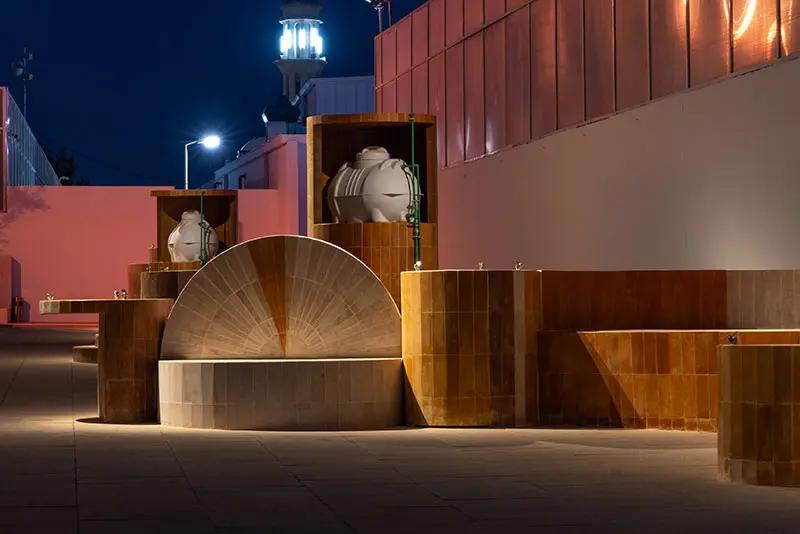
Meanwhile, Agustina Woodgate (Buenos Aires, 1981) has been commissioned to present “The Source” (2026), an installation integrating a series of functional water dispensers made from local materials, poetically addressing access to drinking water in the desert. She researches the historical archives of the Al Ahsa gravity irrigation network, which dates back over 2,000 years.
The Diriyah Contemporary Art Biennale 2026 is presented as a milestone of innovation and cultural openness, with national and international reports highlighting the exponential growth of the Saudi cultural scene, aligned with the aforementioned Vision 2030, and addressing its main challenges in art and culture.
The Biennale is inspired by His Royal Highness the Crown Prince’s “Vision 2030” program and celebrates its third edition with the support and leadership of His Royal Highness Prince Badr bin Abdullah bin Farhan Al Saud, Chairman of the Diriyah Biennale Foundation and Minister of Culture of Saudi Arabia.
The event takes place in JAX, the creative district of Diriyah, strategically located near At-Turaif, a UNESCO World Heritage site, an imposing royal palace citadel nestled in the palm oasis that housed the Emirate of Diriyah, the first Saudi state. The splendor of Diriyah, pride and a reference in the formation of the Kingdom of Saudi Arabia, is now the stage where arts and creative thought are consolidated as a living expression of the Kingdom’s constantly evolving cultural landscape in connection with the world.
The Diriyah Contemporary Art Biennale aims to foster communication between Saudi Arabian art and new national audiences, inviting cultural actors from the region and around the world to co-create a strong on-site cultural axis. Historically, Diriyah has been marked by processions and migrations, by the flow of resilient people whose cultural diversity has left its mark. Today, it represents a revitalized cultural beacon.
Diriyah Contemporary Art Biennale features Nora Razian and Sabih Ahmed as artistic directors and Maan Abu Taleb, May Makki, Kabelo Malatsie, and Lantian Xie as curators, working together to showcase the work of 68 artists from over 37 nations, including 25 new commissions. A fantastic group of young mediators completes the ensemble, helping visitors understand the artworks. The scenography is designed by the studio “Formafantasma,” with communication colored by the creamy iridescence characteristic of the sky in this region.
Conceptually, “In Interludes and Transitions” emphasizes sound and ‘collective observation’ as systems of knowledge and perception of the world, from which we seek to orient ourselves in the present, from cosmos and geology to big data and AI-generated models. The biennale presents a choreography that links human presence to the multitude of species inhabiting the planet. The route is conceptualized around a series of pavilions interspersed with “arenas,” for rest as well as for activating immersive experiences and performances.
Diriyah Contemporary Art Biennale features historic artists like Etel Adnan and Pacita Abad, alongside spectacular immersive installations by Petrit Halilaj and Théo Mercier, whose striking “House of Eternity” is commissioned to occupy one of the central pavilions. A select group of Latin American artists is highlighted: Daniel Lind-Ramos (Loiza, Puerto Rico, 1953), who creates metaphors of his cultural heritage by assembling recycled materials. He presents two installations: one celebrating the preeminence of music as an undisputed ambassador of his country, “Con-junto (The Ensemble)” (2015); and another honoring his people’s fragility during the pandemic with “Ambulance 2020” (2022-2023).
Guadalupe Maravilla (El Salvador, 1976), an artist, choreographer, and ‘healer,’ combines his own displacement story with ancestral knowledge and a unique contemporary expressive force. He exhibits five captivating therapeutic assemblages, colorful totems filled with meaningful elements he collects to heal and transcend.
Daniel Otero Torres (Bogotá, 1985) has been commissioned for Echoes of the Earth (2026), an installation that reflects his deep research into peripheral communities, power structures, and possibilities for collective action. In this case, it is a tribute to environmental activists who risk their lives defending vulnerable localities.
Gala Porras-Kim (Bogotá, 1984) presents here two detailed colored vitrines on paper (2025), alluding to the decontextualization in the criteria for cataloging ‘cultural artifacts’ by global institutions and collecting cabinets.
Oscar Santillán (Ecuador, 1980) presents two commissioned pieces for 2026: “Terraforming Darkness,” a device that visualizes a set of suspended particles as a metaphor for the infinite permutations of artificial thought; and “Anthem,” an interactive installation built around a particular musicality, a futuristic, eco-fictional story as a hypothetical response from certain irritated animals.
Meanwhile, Agustina Woodgate (Buenos Aires, 1981) has been commissioned to present “The Source” (2026), an installation integrating a series of functional water dispensers made from local materials, poetically addressing access to drinking water in the desert. She researches the historical archives of the Al Ahsa gravity irrigation network, which dates back over 2,000 years.
The Diriyah Contemporary Art Biennale 2026 is presented as a milestone of innovation and cultural openness, with national and international reports highlighting the exponential growth of the Saudi cultural scene, aligned with the aforementioned Vision 2030, and addressing its main challenges in art and culture.