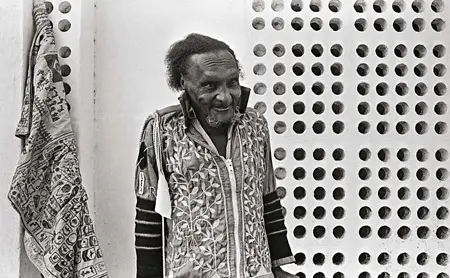
Details and Documents about the Life of Arthur Bispo do Rosário
The recent bilingual book entitled Arthur Bispo do Rosário: El Arte Más Allá de la Locura (Arthur Bispo do Rosario: Art Beyond Madness) reveals never before published documents about the life and work of the Brazilian artist who spent most of his life in a psychiatric hospital and developed his work in complete isolation from the art establishment that currently legitimizes him.
Arthur Bispo do Rosario was born in 1909 in the city of Japaratuba in the state of Sergipe—one of the smallest states in Brazil—located in the northeastern region of the country. Bispo do Rosário has gained great recognition in recent years. He was one of the central figures in the 2012 São Paulo Art Biennial and presented a solo exhibition at the Victoria and Albert Museum in London, during that city's festival last year. His work currently occupies one of the central exhibition halls of the 33rd edition of the Venice Biennale, curated by Massimiliano Gioni. Art Beyond Madness offers exhaustive research by Brazilian psychoanalyst and researcher Flavia Corpas and Brazilian art critic Frederico Morais. The latter is one of the few professionals from the art world who has had the opportunity to meet Bispo do Rosário in person and has exclusive access to personal documents and inventory of the artist's works, many of which are published for the very first time.
The book offers details of the first medical report that sent the artist into an asylum at the age of twenty-nine, where he spent the following fifty years of his life. There are also periodical articles with chronicles of Bispo do Rosário as a boxer who answered to the name Lobo de Mar (Sea-Wolf) or Marino de Bronce (Bronze Sailor); a boxer who was gifted with the hardness of granite. Likewise, the book includes interviews with persons close to the artist, like Humberto Leona, heir to the estate of the Leona clan, one of the most powerful families in Rio de Janeiro at the time Bispo do Rosario worked for them as domestic help, following a streetcar accident that took him away from the ring.
Frederico Morais analyzes the work by Bispo do Rosário, an artist who "never quite lived in a permanent delirious state, as he knew things" (Folha, São Paulo, Silas Marti). In his analysis of the artist's work, Morais addresses inquiries in the field of contemporary art and discusses the relationship between art and madness. According to the author it is about: "… madness (that) must be understood as circumstance, as war, as hunger, as political repression, homosexuality, race, the family environment or the cultural traditions of a country; a condition capable of impregnating the creative act and giving it new meaning, but a circumstance nonetheless."
The publication received first place in the selection of projects sponsored by the city of Rio de Janeiro through PRO Artes Visuales in 2011. It is the first edition published by the NAU publishing house, in Brazil. The hardcover book contains 296 pages. More information is available at: