ExhibitionJanuary 20, 2016
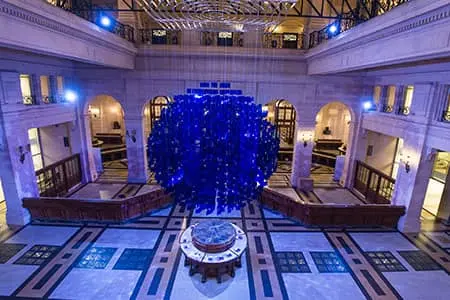
Flashes of Blue
The Kirchner Cultural Center is paying homage to Julio Le Parc (Argentina. 1928) by installing his Esfera azul ("Blue Sphere") in the central vestibule to its main building and projecting, in one of its auditoriums, short films about important exhibitions—"Le Parc Lumière", "Biennale de París", "Di Tella"—in the career of this key figure in kinetic art. There is no debating the splendid and luminous trajectory followed by Le Parc, renowned globally as an explorer of motion and light, and the import of his career is not diminished by the controversies surrounding the Cultural Center. The Center's current location, the old Correos y Telégrafos palace, was designed by Norbert Maillart in the late Nineteenth Century as the headquarters of Argentina's postal service. In 2010 it was inaugurated as the Bicentenario Cultural Center, but it never functioned as such due to, among other things, delays in completion. Then, former president Néstor Kirchner died and the Center—like hundreds of roads, buildings, and monuments—was renamed in his honor, becoming yet another propaganda vehicle for the government that just ended its term in the country. With ten floors, three basements, fifty (small) exhibition galleries, sixteen rehearsal rooms, eighteen vestibules, twenty dressing rooms, three (projected) restaurants, two concert halls (including the one known as "Blue Whale"), dome with viewing platform, the overambitious building saw its initial remodeling budget tripled and has very limited programming. The former government admitted spending at least US$303 million, and it was never clarified what its working budget will be or who will oversee its activities. After its opening in 2012 of the Julio Le Parc Cultural Space in Guaymallén (Mendoza), the artist's native city, Le Parc can feel like a prophet in his own land, which he had left in 1958 for Paris, where he has lived with his wife—artist Martha Le Parc—and three children, after receiving a grant from the French government. In Paris in 1960 he launched the Groupe de Recherche d'Art Visuel alongside other artists, carrying forward his investigations in optics and later incorporating motion to his work. The winner of many awards and distinctions, Le Parc saw his 2013 retrospective at the Palais de Tokyo become a categorical audience success. The playful flashes of the gleaming, imposing Esfera Azul—four meters in diameter, composed of 3500 translucent blue acrylic plaques, created specifically for this homage—multiply by a factor of one hundred the surrounding lights and shapes and make them dance. The gaze is captured and seduced by this work as it converses with the space and its visitors, inducing "the instability of our vision and challenging our habitual way of looking," delighting us all. This motion-based work synthesizes years of the artist's career and adheres to his premise of incorporating audience participation, as each viewer becomes "the subject of observation for others." In this way, the relationship between geometry, space, and body shift according to the viewer's motion and vantage point. Even the retinal dialog between the vibrantly shaped and colored work of art and the brain of the viewer who reconstructs them is conditioned by our subjectivity and cultural inscription.
Please click here to watch the video.