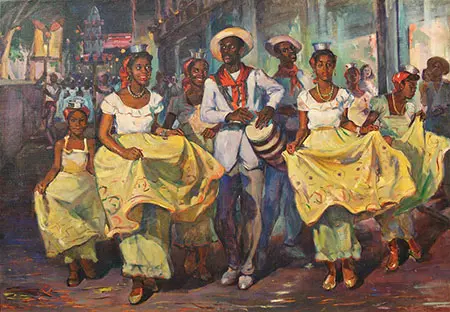
Cuban Art and Identity: 1900-1950
Cuban Art and Identity: 1900-1950 will remain open to the public at the Vero Beach Museum through February 2nd, 2014. Curated by Juan A. Martínez, the show includes paintings from the first 50 years of Cuba's republican history, a period of national construction and of the definition of "Cubanness" through the arts.
The exhibition's goal is to present a view of Cuban painting of the first five decades of the republic with an emphasis on its themes, rather than its styles. This is done through the study of four main themes found in academic and modern painting: the Cuban countryside, Havana interiors, religious traditions, and music.
With regards to Havana interiors, the show includes examples from Amelia Peláez's and René Portocarrero's still life's, through Cundo Bermúdez's figurative compositions, revealing the drive to represent Cuban identity not just in terms of content but through a concrete formal device: Neo-baroque. African- and Catholic-inspired spirituality are in clear contrast in the work of Wilfredo Lam and Fidelio Ponce de León.
In terms of traditions, since the early twentieth Century popular music has been one of Cuba's greatest export assets, and it is much better and more broadly known that the country's literature and visual arts. Musical forms known as rumba and son were particularly popular during the 1920s and 1930s, inspiring a vast number of paintings included here, by artists like Eduardo Abela, Oscar García Ribera, Carreño, and Enríquez, among others.