Book ReviewsNovember 6, 2020
Cuba habla. Entrevistas con 28 artistas contemporáneos
Authors: Jérôme Sans and Laura Salas Redondo
Edited by: Scriptum Srl, Rome
Spanish, 2019
We are very pretty,
but we have to understand each other.
Bicycle-taxi driver
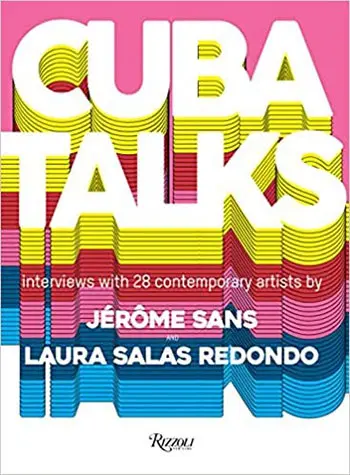
A volume of interviews with Cuban artists was recently published under the title Cuba habla. Entrevistas con 28 artistas contemporáneos cubanos (Cuba Speaks. Interviews with 28 Contemporary Cuban Artists), by Jérôme Sans and Laura Salas Redondo. 1 The book adds to the modest number of documents that help us understand the evolution of Cuban art in the last three decades. 2
In the context of Cuban art, there is no publication with these characteristics since it’s not a series of critical texts, but rather the voices of the artists themselves, interpellated by the book’s authors. Each interview covers ten to thirteen pages with questions that prompted the artists to elaborate on their aesthetics and sociopolitical criteria, supplemented with large images of some of their artworks.
Of the twenty-eight interviewees, fourteen are young artists who have shaped their aesthetics with sustained critical reflections on current Cuban realities. Four are some of the most outstanding creators who, in addition to producing art, are also consummate pedagogues. Between these two groups are ten artists who either have already developed solid international careers or are in active pursuit of it.
The selections naturally respond to the authors’ judgments and certain extra-aesthetic circumstances; nonetheless, the publication has reached a substantial balance. Although they represent a limited number of artists within the entire Cuban contemporary art scene, the authors have managed to successfully measure the generational component, the aesthetic inclinations, and the personal and professional experiences accumulated in the local and international artistic fields. This selection helps us appreciate the aesthetic quality of the works—sometimes inserted in the social dimension, or expressed through performance practices and other creative variants of contemporary art—and the complexities of being an artist working in the Island or concerning it.
How do these artists think? What are their concerns? What decisions do they make? These voices offer us a present-day vision of Cuban art’s diverse, rich, and arduous environment. It, therefore, constitutes a document that merges the creative and the personal. Although both are supposed to be intrinsically related, we do not usually have the opportunity to learn from the creators themselves.
For instance, when Jérôme Sans asks Adrián Melis to describe his work, he replies: "…the procedural nature of my work makes me produce new structures that feed on the absence of real structures...”3 When Laura Salas asks Lázaro Saavedra why he decided to live and work in Cuba, he replies: “Because it was not a decision. Because most of my colleagues in the 1980s did indeed make the decision to stay abroad and live and work outside of Cuba. Because I didn't stay. They left.”4
One reflection is aesthetic and the other one political. In Cuban art, they are inseparable.
NOTES
1. Rizzoli Libri, Mondadori Electa S.p.A., Milan, 2019. The artists are: Abel Barroso, Alejandro Campins, Elizabet Cerviño, Iván Capote, Yoan Capote, Los Carpinteros, Celia & Yunior, Susana Pilar Delahante, Leandro Feal, Diana Fonseca, Carlos Garaicoa, Flavio Garciandía, Osvaldo González, Kcho, Hamlet Lavastida, Glenda León, Reynier Leyva Novo, Luis López-Chávez, Carlos Martiel, Yornel Martínez, Adrián Melis, José Mesías, Michel Pérez, Eduardo Ponjuán, Wilfredo Prieto, René Francisco Rodríguez, Lázaro Saavedra, and José Yaque.
2. Among them, three anthologies are worth a special mention: Déjame que te cuente. Antología de la crítica de los 80, comps. Margarita González, Tania Parson, and José Veigas, ed. Elvia Rosa Castro, Artecubano Ediciones, La Habana, 2002; Antología de textos críticos. El nuevo arte cubano, comps. Magaly Espinosa and Kevin Power, Perceval Press, Santa Mónica, Spain, 2006; and Nosotros los más infieles. Narraciones críticas sobre el arte cubano (1993-2005), comp. Andrés Isaac Santana, Cendeac, Murcia, Spain, 2007.
3. Cuba habla, op. cit., p. 256.
4. Ibid, p. 321.
Edited by: Scriptum Srl, Rome
Spanish, 2019
We are very pretty,
but we have to understand each other.
Bicycle-taxi driver
A volume of interviews with Cuban artists was recently published under the title Cuba habla. Entrevistas con 28 artistas contemporáneos cubanos (Cuba Speaks. Interviews with 28 Contemporary Cuban Artists), by Jérôme Sans and Laura Salas Redondo. 1 The book adds to the modest number of documents that help us understand the evolution of Cuban art in the last three decades. 2
In the context of Cuban art, there is no publication with these characteristics since it’s not a series of critical texts, but rather the voices of the artists themselves, interpellated by the book’s authors. Each interview covers ten to thirteen pages with questions that prompted the artists to elaborate on their aesthetics and sociopolitical criteria, supplemented with large images of some of their artworks.
Of the twenty-eight interviewees, fourteen are young artists who have shaped their aesthetics with sustained critical reflections on current Cuban realities. Four are some of the most outstanding creators who, in addition to producing art, are also consummate pedagogues. Between these two groups are ten artists who either have already developed solid international careers or are in active pursuit of it.
The selections naturally respond to the authors’ judgments and certain extra-aesthetic circumstances; nonetheless, the publication has reached a substantial balance. Although they represent a limited number of artists within the entire Cuban contemporary art scene, the authors have managed to successfully measure the generational component, the aesthetic inclinations, and the personal and professional experiences accumulated in the local and international artistic fields. This selection helps us appreciate the aesthetic quality of the works—sometimes inserted in the social dimension, or expressed through performance practices and other creative variants of contemporary art—and the complexities of being an artist working in the Island or concerning it.
How do these artists think? What are their concerns? What decisions do they make? These voices offer us a present-day vision of Cuban art’s diverse, rich, and arduous environment. It, therefore, constitutes a document that merges the creative and the personal. Although both are supposed to be intrinsically related, we do not usually have the opportunity to learn from the creators themselves.
For instance, when Jérôme Sans asks Adrián Melis to describe his work, he replies: "…the procedural nature of my work makes me produce new structures that feed on the absence of real structures...”3 When Laura Salas asks Lázaro Saavedra why he decided to live and work in Cuba, he replies: “Because it was not a decision. Because most of my colleagues in the 1980s did indeed make the decision to stay abroad and live and work outside of Cuba. Because I didn't stay. They left.”4
One reflection is aesthetic and the other one political. In Cuban art, they are inseparable.
NOTES
1. Rizzoli Libri, Mondadori Electa S.p.A., Milan, 2019. The artists are: Abel Barroso, Alejandro Campins, Elizabet Cerviño, Iván Capote, Yoan Capote, Los Carpinteros, Celia & Yunior, Susana Pilar Delahante, Leandro Feal, Diana Fonseca, Carlos Garaicoa, Flavio Garciandía, Osvaldo González, Kcho, Hamlet Lavastida, Glenda León, Reynier Leyva Novo, Luis López-Chávez, Carlos Martiel, Yornel Martínez, Adrián Melis, José Mesías, Michel Pérez, Eduardo Ponjuán, Wilfredo Prieto, René Francisco Rodríguez, Lázaro Saavedra, and José Yaque.
2. Among them, three anthologies are worth a special mention: Déjame que te cuente. Antología de la crítica de los 80, comps. Margarita González, Tania Parson, and José Veigas, ed. Elvia Rosa Castro, Artecubano Ediciones, La Habana, 2002; Antología de textos críticos. El nuevo arte cubano, comps. Magaly Espinosa and Kevin Power, Perceval Press, Santa Mónica, Spain, 2006; and Nosotros los más infieles. Narraciones críticas sobre el arte cubano (1993-2005), comp. Andrés Isaac Santana, Cendeac, Murcia, Spain, 2007.
3. Cuba habla, op. cit., p. 256.
4. Ibid, p. 321.