Art NotesSeptember 7, 2010
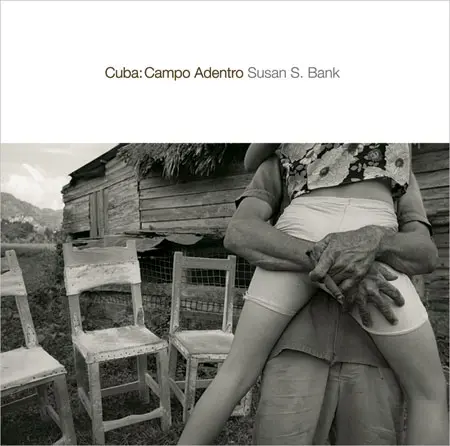
Cuba: Campo Adentro de Susan S. Bank
The book by Susan S. Bank, entitled Cuba: Campo Adentro, contains two narratives: one on the islanders, and another on the publication itself. Do they somehow intersect? Bank is one of many photographers who have gone to Cuba in search of their own voice, or to use the talents they already possessed to reverberate through the rundown walls of Old Havana. Some such artists are Lorenzo Castore, Haris Kakarouhas, Elaine Ling, and Craig Barber, among others. The majority of works by these photographers concentrate on Havana. Bank¿s is one of the few works about the backcountry, the rural areas in the Pinar del Río province - where 70 percent of tobacco cultivated in Cuba is produced; thus, the title Bank chose for the book: Campo Adentro (Into the Backcountry). According to Bank, in order to complete the project, she visited several times - over a period of five years - the Cuajaní community located in the Viñales Valley. Bank focused on ten households as she continuously photographed their members. Unlike works by many other photographers who have visited the island - including the great Walker Evans - and show in their works an ephemeral relationship between the subjects and the persons behind the camera, the images by Bank reveal a sort of intimacy that emerges from a bonding that has been established over a long period of time. Evans photographed Havana in 1933 and the images from that three-week trip can be seen in the book entitled Walker Evans: Cuba (The J. Paul Getty Museum, 2001). The majority of these works are outdoor images of people on the streets. The photographer's only image taken from an interior space is one taken inside a hair salon. On the other hand, Bank works by interacting with the Cuajaní families as if she were one of them. As a result, she is able to capture her subjects, not only while they behave spontaneously, but also in intimate moments: caressing; embracing; cooking; being examined by a physician in their own homes, etc. The entire project by Bank offers a good glimpse into the life of a community of Cuban farmers from the Twenty-First Century. Whether farmers in other countries lived a hundred years ago is questionable. Of course, that might perhaps be true if compared to the majority of farmers in the U.S. or in Switzerland. But if these are compared to most farmers leaving in South-America or Africa, then one could conclude that, although modest, the standard of living of the Cuban peasant is definitely better. Bank¿s approach to photography is influenced by ¿committed¿ photo-journalists such as Mary Ellen Mark - under whose tutelage Bank developed her trade - in works characterized by strong foregrounds, an astute sense of framing the subjects, and an elegant manner of employing the surroundings to contextualize the images. Such is the case of the works by Bank entitled Julieto in the Rain and Julio Sifting Rice with Osbel - in which one part of the body in the portrait lies outside the frame without negatively affecting the composition. These images are also an example of the background utilized to contextualize the actions depicted. Bank also knows how to alternate images with stable horizontal lines and other, more dynamic ones, as in Guillermo and Niece and Boy with Rope, in which the camera points downward. And finally, like many other photo-journalists after Henri Cartier-Bresson, Bank has a knack for capturing disconcerting images, as in the case of her photographs Guillermo on Rain Cape, Tobacco Birdman, and Pigman. If to all of these we add images such as Manuel (Toti) on Horse - in which a multiplicity of things that would be unlikely occur at once do actually take place all at once - then the viewer has completely bought into Bank¿s vision and is thus willing to be seduced by whatever the photographer chooses to show. Despite Bank¿s powerful images and the extent to which her theme was untapped, the artist found it very difficult to publish her book. After sending several mock-up...