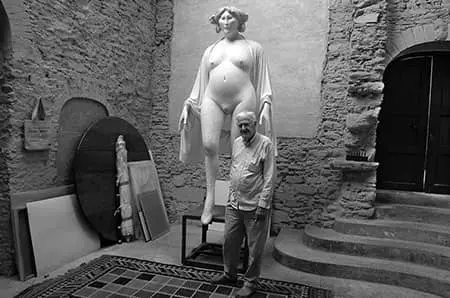
ObituaryFebruary 11, 2016
Cornelis Zitman
Cornelis Zitman, the Dutch-born Venezuelan sculptor, passed away in Caracas last January 10th, at the age of 89. He leaves behind an important legacy for the art of the region. Zitman's career took place mainly in Venezuela, where he moved at 21 after graduating from the Fine Arts Academy in The Hague. After refusing military service as a conscientious objector opposed to his country's policies in Indonesia, he reached Venezuela in a Swedish oil tanker. He worked as a designer and, later, as the director of a furniture-making concern. Zitman's work was exhibited for the first time in 1958, at Caracas' Galería de Arte Contemporáneo. In conversation in 1980, Zitman told me this: "I think I am not a typical artist. I am the opposite of a bohemian dreamer. I do dream, but in a very serious way. I am a practical-minded person who has worked in industry and in academia, and has had numerous experiences where I felt I was capable of achieving positive things. I came back from all that somewhat disillusioned, but regained the feeling through sculpture. I think sculpture embraced me. It is my refuge." Although Zitman's most intensive education in The Netherlands had been in drawing and painting, when confronted with the ethnic diversity of the Americas, he grew passionate about sculpture. In 1961, he traveled back to The Netherlands to study foundry techniques; in 1964 he worked at Pieter Starreveldt's workshop, before returning for good to Venezuela. In 1971 Zitman exhibited for the first time at the Dina Vierny Gallery in Paris, and in subsequent years his work was seen in Venezuela, France, Switzerland, The Netherlands, the United States, and Japan. Among other honors, he won the National Sculpture Prize at the Visual Arts Salon in Caracas (1951); the Budapest Sculpture Biennial Prize (1971); and the Jakone Museum's Kotaro Takamura Grand Prize in Japan (1982). In 2005 he was inducted into The Order of the Netherlands Lion. Zitman tells us that he arrived at his Paris exhibition after spending a few days in Amsterdam, and upon entering the gallery he was impressed by suddenly seeing his own sculptures with European eyes. He talks of an "Amsterdam Zitman" who reemerged for a moment when he visited his Dutch family; in Paris he saw, thanks to the distance thus gained, what was close and natural to the "Venezuela Zitman." "I found an immense density in that gallery: the sculptures had weight," he says. "What I liked best was the fact that it wasn't modern art, but something more ethnographic, like those forms that reach us from Africa or those pre-Columbian forms you find in dimly-lit, mystery-filled shops." An admirer of Renaissance Italian sculpture and of Dutch painting, Zitman was a sculptor of rotund shapes and a draftsman of lithe figures. When he drew, he liked to erase, blur, and very carefully retrace. He wanted for "everything to develop full of light, and for shadows, if there were any, to always be transparent." Of his sculptures, Marta Traba once said that they belonged "to the tribe of Zitman." "I liked that," commented the artist. "It is like a territory inhabited by people of different sizes… but the small ones are not really small, just farther away, and the large ones are inside or very near." Zitman lived to the end in the company of his tribe, in his home in Sorocaima, a former tobacco-drying facility he transformed—with his wife, Vera Roos—into a refuge for his family, his art, and his visiting friends. It was there that Marcel Marceau made Zitman's portrait and Lindsay Kemp danced with the masks of Zitman's sculptures. For them, Zitman's home-workshop was also a stage. ...