Art NotesJune 17, 2015
With Carlos Cruz-Diez, Jr
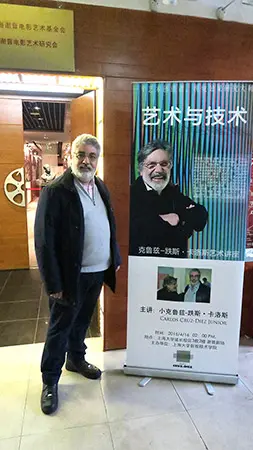
Carlos Cruz-Diez, Jr. is a connoisseur of the world of art and an expert on what goes on behind the scenes in that world. As indeed he should be, having spent over 40 years in the company of one of the most distinguished figures in contemporary art: Carlos Cruz-Diez, his father. The experience he has gained during those years of supporting the artist's work and wide range of activities, and the knowledge he has acquired by managing the Atelier Cruz-Diez and becoming skilled in the use of art technology were the subject of the talks he recently gave in China. ECL: You recently gave three lectures in Shanghai, China on "Art and Technology – Art and Architecture." What prompted the host institutions to invite you to speak on that subject? CC-D, Jr.: I gave my first lecture at the East China Architectural Design & Research Institute (ECADI), in Shanghai, on April 14. The ECADI plans, coordinates, and constructs infrastructure projects in China and other parts of the world, and has a staff of 400 architects. My remarks focused on the knowledge we have acquired through our involvement in projects designed to integrate art into architecture in a number of countries. As we all know, Chinese cities are developing very rapidly, and are in need of specialized consultants to advise them in that field. ECL: What specific aspects of this process did you address in your lecture? CC-D, Jr.: I spoke about how important it is, from a societal perspective, to integrate art into architectural works. The bonds that can develop between a community and an architectural project in an urban environment are of an emotional nature that can provide people with a point of reference and can give them a feeling of belonging and even a sense of civic pride. An artist's involvement, in the design of public spaces can lead to unprecedented states of sublimation and can stimulate our forgotten capacity for wonder by contributing creative new solutions to the community. That is why I stressed that the planning and execution of a work of art in urban surroundings and in a human habitat must be the result of a joint effort undertaken by a team that includes the artist, the urban developer, the architect, the engineer, the landscape designer, and the technicians, craftsmen, and promoters. As an example of this idea, I showed photographs of the construction of the Marlins Great Plaza Chromatic Induction in a Double Frequency, the work we installed at the Miami Marlins Ballpark Stadium in the United States. Another work that amazed the audience, because it is so enormous, was the Ambientación Cromática [Chromatic Environment] at the Guri damn in Venezuela. As a result of this exchange of ideas, I was appointed as an advisor to the East China Architectural Design & Research Institute on projects involving the integration of art and architecture. ECL: What sparked your interest in China? CC-D, Jr.: For some time now we have wanted to accept the invitations from several Chinese universities and museums that are interested in Cruz-Diez's work. So, in 2010, I talked to my father and suggested organizing an exhibition there. We designed an "exhibition of ephemeral works," on a computer, to be sent as "data" over the Internet and printed onsite, with digital projections and other elements to be assembled by the museum or gallery staff, all of which would save on transportation and insurance costs as well as customs fees. The exhibition was a partial retrospective of Cruz-Diez's work which, since then has been shown in several Chinese cities; at the Guandong Museum of Art; the Ningbo Museum of Art; the Jiangsu Provincial Art Museum; the He Nan Art Museum and the Museum of the University of Fine Arts in Peking. The welcome this exhibition has rece...
Gallery