PublicationDecember 20, 2010
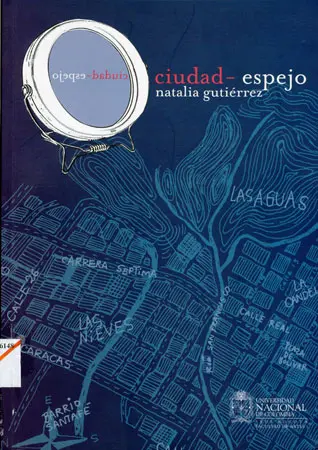
City-Mirror: The Bogota of the Artists as the Objective
Natalia Gutiérrez analyzes in this book the way a group of Colombian artists-expanding at least three generations-confront the idealization fantasies of a Bogota that could had been built by many of the city's institutional representations. The nine artists and three collectives that conform the group emerge from Colombian art at different moments during the last forty years. They share an interest in exploring the city, using photography or video, and maintaining in a visible emotional distance. An artist that emerged during the first part of the 1970s and pioneered the use of photography as an artistic practice, Miguel Ángel Rojas heads the list of this group of artists. He is followed by José Alejandro Restrepo-in the field of video-and Rolf and Heidi Abdenhalden, who emerged onto the theater scene a decade later. At about the same time, the work by Raúl Cristancho became known and Jaime Iregui's emerged a little later on. Nonetheless their projects in Ciudad¿Espejo (City¿Mirror) were produced between the second-half of the 1990s and the fist-half of this current decade. Thus, these specific artistic proposals coincide with those by a younger generation of artist like Jaime Ávila and Rosario López-from the beginning of the 1990s-or like Pablo Adarme, Sandra Mayorga, Carolina Salazar, Milena Bonilla, and María Isabel Rueda, whose works date from around 2000. The youngest artists in the group are José Tomás Giraldo and Eduardo Consuegra, who began to present their respective works publicly during this decade. It appears that the decision to embark in this project originated with a need to respond to the suspicions and prejudices that accumulate around contemporary art, particularly with regard to the art that combines artistic disciplines and that, above all, is based on practices closely associated with photography and video. Natalia Gutiérrez sidesteps the usual conventions employed to talk about art and the city. She is not interested in the works by artists who are graphic reporters, or in those who develop taxonomies to ethnographically or archeologically inventory the city. Nor is she motivated by those dedicated to formally take advantage of urban life. Gutiérrez's interest is awaken by this peculiar group of artists who, in spite of responding to different conceptions and representations, agree to "speak of their time as if they were not referring to it," to inquire about the forces that permeate through the people, objects, and places that constitute the life in Bogota. According to Natalia Gutiérrez, these Colombian artists "attempt to 'photograph' the ideological forces that use the city as their stage." These essays reveal the enormous attention the author gives to all the aspects of the analyzed works, so much so that these appear to be participating in the dialogue that is established in Ciudad¿Espejo. It is necessary to note that this dialogue appears exhaustively depurated, perhaps as a result of the multiple encounters by the author with each of the artists, works, and authors associated with the writing process. Ciudad¿Espejo unfolds with a feeling of confidence in the ability art has to elicit confrontations with history itself. Such confidence appears to be generated by the sense of solidarity developed between the artists, their works, and the author. Nonetheless, the book is not punctuated by certainties but rather by the questions and doubts such encounters have signaled to be intrinsic to the artistic endeavor. Within the wide-ranging number of authors Natalia Gutiérrez dialogues with in Ciudad¿Espejo, there are some that are also accomplices of the artists to such a degree that they have become another working tool. To the artists, theory has a structural function, especially when used as a tool in the literal sense. One does not need a hammer or a drill unless their use is specifically required, as they function is to improve something or make something happen. Tools are not an end in themselves...