ExhibitionJanuary 30, 2020· By Christine Frèrot
Christian Boltanski, “Faire son temps” (Life in the Making)
Christian Boltanski's exhibition at the National Museum of Modern Art in Paris is the most important retrospective ever devoted to this French artist (Paris, 1944). Forty sections, both thematic and chronological, scan a route in which various techniques alternate. Among the exhibits there are photographs, objects (light bulbs), electric cables, mirrors, labels, and used clothing, on which videos of actions are projected. Some of these were made in Latin America (Animitas, in the Chilean desert in 2014, and Mysteries, north of Patagonia, in 2017). From its beginnings as an artist, in 1967, Boltanski scrutinized the life of human beings and what remains after death. Working with inventories and archives, and with the creation of photographic albums and objects, the artist tried, through small stories, to reconstitute lives in their anonymous disappearance. Boltanski’s practice thus reconciles the ridiculous (and ephemeral) character of all action with every civilization’s desire for permanence and preservatio. His oeuvre manifests his wish to seize life and the passage time in order to fight against oblivion.
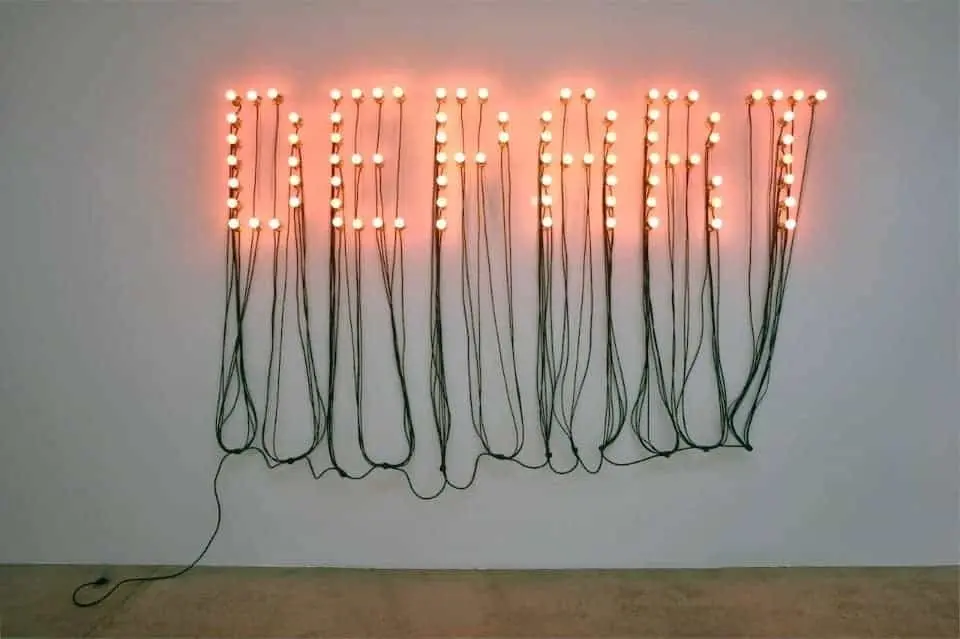
The words DÉPART (Departure) and ARRIVÉE (Arrival) (made with light bulbs, including their sockets and electrical cables) open and close the exhibition’s circuit, thus symbolizing, for the artist, life itself: that which escapes us with the passing of time. The show begins with a photographic ensemble that evokes aging (black and white, 2007), in which photographs of Boltanski at all ages are superimposed. The tour, lacking a real chronology, continues with the alternation of techniques that include paintings (1967), photographs, the Albums of photos of the D. family: 1939-1964 (1971); cardboard figurines made of wire and cut-out copper threads in Théâtre d'ombres (Shadow Theatre, 1984-1997), a work inspired by Chinese shadow theatres; the light bulb named Heart (2005), whose flickering follows the beating of a heart (a work that the artist took up again for his permanent installation on the Japanese island of Teshima, which presents more than 70,000 heart recordings from different countries); The Coat (1991, an installation of a coat lying on the ground and surrounded by LED light bulbs (inspired by the moment when the nuns pronounce their vows, lying directly on the ground); and also Twilight (light bulbs, black cables, 2015), an installation where every day a light bulb goes out: a reflection on the passing of time and the precariousness of existence. In The Passage (a silent black-and-white video projection on canvas made especially for this exhibition), a crowd, seen from behind, gradually disappears: a disappearance that concludes this passionate meditation on a life’s difficult voyage.
The words DÉPART (Departure) and ARRIVÉE (Arrival) (made with light bulbs, including their sockets and electrical cables) open and close the exhibition’s circuit, thus symbolizing, for the artist, life itself: that which escapes us with the passing of time. The show begins with a photographic ensemble that evokes aging (black and white, 2007), in which photographs of Boltanski at all ages are superimposed. The tour, lacking a real chronology, continues with the alternation of techniques that include paintings (1967), photographs, the Albums of photos of the D. family: 1939-1964 (1971); cardboard figurines made of wire and cut-out copper threads in Théâtre d'ombres (Shadow Theatre, 1984-1997), a work inspired by Chinese shadow theatres; the light bulb named Heart (2005), whose flickering follows the beating of a heart (a work that the artist took up again for his permanent installation on the Japanese island of Teshima, which presents more than 70,000 heart recordings from different countries); The Coat (1991, an installation of a coat lying on the ground and surrounded by LED light bulbs (inspired by the moment when the nuns pronounce their vows, lying directly on the ground); and also Twilight (light bulbs, black cables, 2015), an installation where every day a light bulb goes out: a reflection on the passing of time and the precariousness of existence. In The Passage (a silent black-and-white video projection on canvas made especially for this exhibition), a crowd, seen from behind, gradually disappears: a disappearance that concludes this passionate meditation on a life’s difficult voyage.