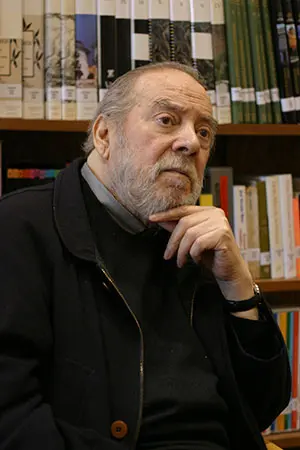
ObituaryMay 8, 2015
César López-Osornio
Cesar López-Osornio was a prominent painter that belonged to the Ciudad de La Plata Group, an art collective that occupies an important place in Argentine art. He studied at the Faculty of Fine Arts of the Universidad de La Plata, where he eventually also taught. A muralist and designer, López-Osornio traveled to Japan on a scholarship in 1960 and lived there until 1963. During that stay he studied Oriental Art in the Art Department of Osaka University of Technology under the direction of Professor Toro Mori, and Landscape Architecture at the University of Kuodai in Kyoto. In Japan he exhibited in galleries in Osaka, Tokyo, Kyoto and Kobe. On his return to Argentina he was forced to leave the country and sought asylum in Venezuela for a period of five years. There he worked in the Faculty of Architecture of the Universidad Central de Venezuela where he taught Landscape Architecture and perception. López-Osornio endorsed Herbert Read's idea of art as an escape from chaos, and sought order within the confines of geometry. But his is a very peculiar geometry. While he adhered to circles or squares as the basis of his work and also introduced other geometric forms, the austerity and structural precision of the images do not hide, according to Japanese art critic Kazuo Akama, the "unusual ambiguity of his works." He never yielded to a superficial orientalism or let Eastern art influence his technique. However, the sense of silence as well as the depth and enigmatic nature of his images do reflect an Eastern influence in his work. His small series like The Other Geometry or Floating Suns are infused with a poetic mysticism that is both mysterious and lyrical. The dynamism and vitality of his paintings are supported by the multitude of elements that he combines to form a harmonious whole. He was daring in the use of a palate always at the service of playing on opposing forces which appear to be about to find the mystery and revelation of things. Sfumatos, concealments and the appearance of thick geometric lines, to frame an interior space or a dominant contour, alternate in intensely poetic precisions and imprecisions. He was an untiring teacher of Muralism and Vision at the Universidad Nacional de La Plata, at the Universidad Central de Venezuela and at the Department of Sociology of the Universidad Nacional de Zaragoza. As a teacher of Muralism, López-Osornio transformed the existing structure by combining muralism with stained glass, mosaic and other techniques related to muralism. As a teacher of Vision he was influenced by his own teacher during his formative years: Hector Cartier, a visual artist from La Plata and an expert in that subject. Osornio Lopez was also a theoretical advocate of the Gestalt and its misconceptions. In 1999 he returned to Argentina to found and direct the Museo de Arte Contemporáneo Latinoamericano (MACLA) in La Plata, with the contributions of Latin American artists based in Europe. In 2005 the museum was recognized as the Cultural Institution or "Museum of the Year" by the Argentine Association of Art Critics. In addition to the significant initial donations that gave rise to the museum, the institution subsequently received a donation from Madi Internacional—back then led by Arden Quin: drawings by Julio Silva and nearly one hundred beautiful works by Tomasello. As founder and director of the museum, the work of César López Osornio was, without a doubt, remarkable not only for the exhibitions he organized but also for his efforts to acquire a space that suited the purposes of the institution. According to him it was the first Museum of nonrepresentational Latin American Art. He always f...