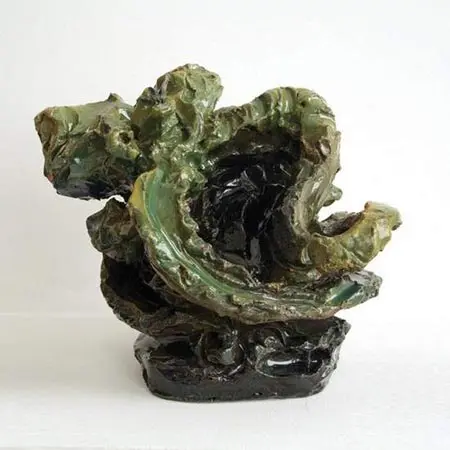
Ceramics by Lucio Fontana
For the first time in the US, the Aspen Art Museum presents an individual exhibition of works by Italian-Argentine painter, sculptor, and ceramist Lucio Fontana, one of the most innovative artists of the Twentieth Century, It will remain open through October, 2012.
Lucio Fontana was born in Rosario, Argentina, in 1899, and died in Comabbio, Italy, in 1968. He spent his life shuttling between the two countries and presented his first exhibition in 1930, at the Il Milione gallery in Milan. In his travels through Italy and France, Fontana worked with expressionist and abstract artists. In 1840 he founded the Altamira Academy in Buenos Aires and launched the White Manifesto, which states that "Matter, color, and sound in motion are the phenomena whose simultaneous development constitutes the new art." Later came the Theoretical Manifesto of Intra-Spatialism, which extends his theories around this movement.
Fontana took part in the São Paulo Biennial and in many exhibitions in London, Paris, New York, Europe, and several Eastern countries. His works are now in the permanent collections of more than 100 museums around the world.
This first stage of an exceptional exhibition, which covers essentially the period between 1930 and the late 1960s and is comprised of a dozen selected works, announces the use of ceramics as an axis in the development of Fontana's creative work, marked by a varied language both in the combination of techniques and materials, and in its forms.
Fontana is renowned for his works of the 1950s and 1960s inscribed in the Concetti Spaziale, characterized by spatial atmospheres and ripped canvases, which outlined the sin of what he dubbed "an art for the Space Age." Many of these works, initially molded in clay, are part of what became his ceramic oeuvre, highly baroque in content, where Fontana incorporated painting and sculpture.