AwardDecember 17, 2019
Cecilia Vicuña, Velázquez Prize
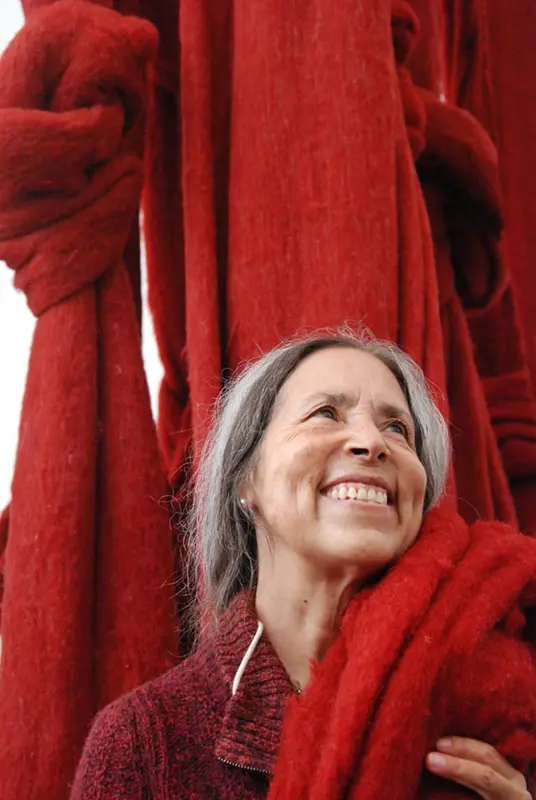
The Chilean artist Cecilia Vicuña was awarded the 2019 Velázquez Prize for Visual Arts by the Ministry of Culture and Sports last November 19th. This award, endowed with 100,000 euros, is given out each year to an artist from the Ibero-American community of nations.
The members of the jury, which met in Madrid, based their decision on Vicuña’s “outstanding work as a poet, visual artist, and activist” and on a “multidimensional art that interacts with the earth, the written language, and weaving.” The jury added that Vicuña is a “creator of a special kind of poetry that traverses ecological awareness, the city, and the artistic institution,” and that “her work is indebted to a millenary knowledge restructured through performances, installations, sculptures, books, and gestures of daily life.”
Cecilia Vicuña (Santiago, Chile, 1948) is a poet, filmmaker, and activist. Exiled since the early 1970s after the military coup against president Salvador Allende, she has lived in New York since 1980. She holds a bachelor’s degree from the School of Fine Arts at Universidad de Chile and a masters from the Slade School of Fine Arts in London. She began her artistic practice in the mid-1960s in Chile. Her multidimensional works begin as a poem or an image, which she then transforms into films, songs, sculptures, and collective installations. Her ephemeral installations are specific to spaces such as nature, streets, or museums, and combine rituals and assemblages. She calls her works “precarious'.
Vicuña has published books of art and poetry, and was appointed Messenger Lecturer 2015 by Cornell University (New York), a distinction granted to authors who contribute to the evolution of civilization with the aim of raising the moral standards of politics, business, and social life.
Her work has been exhibited in various institutions, such as Tate Gallery (London), Museo Nacional de Bellas Artes (Chile), Museo de Arte Contemporáneo (Chile), Institute of Contemporary Arts - ICA (London), Whitechapel Art Gallery (London), Berkeley Art Museum (California), Whitney Museum of American Art, and MoMA (New York).
The purpose of the Velásquez Prize, created in 2002, is to give institutional recognition to a visual artist whose entire oeuvre has made an outstanding contribution to Spanish and Latin American culture. This year's jury was chaired by Román Fernández-Baca, general director of Fine Arts and Cultural Heritage; Begoña Torres González, deputy director for the Promotion of Fine Arts, served as the jury's secretary. The spokespersons were Marina Vargas Gómez, representing the Spanish Union of Contemporary Artists (Unión AC); Tania Pardo Pérez, deputy director of the Centro de Arte Dos de Mayo, representing the Real Academia de Bellas Artes de San Fernando; Nuria Enguita Mayo, director of Bombas Gens, standing for the Asociación de Directores de Arte Contemporáneo (ADACE); José María de Francisco Guinea, director of Stampa, on behalf of the Instituto de Arte Contemporáneo (IAC); María José Magaña Clemente, head of the Area of Visual Arts at the Cervantes Institute, stood for Women in Visual Arts (MAV); art critic and curator Iván de la Nuez Carrillo, and curator and researcher José Luis Blondet were both appointed by the Ministry of Culture and Sports.
The members of the jury, which met in Madrid, based their decision on Vicuña’s “outstanding work as a poet, visual artist, and activist” and on a “multidimensional art that interacts with the earth, the written language, and weaving.” The jury added that Vicuña is a “creator of a special kind of poetry that traverses ecological awareness, the city, and the artistic institution,” and that “her work is indebted to a millenary knowledge restructured through performances, installations, sculptures, books, and gestures of daily life.”
Cecilia Vicuña (Santiago, Chile, 1948) is a poet, filmmaker, and activist. Exiled since the early 1970s after the military coup against president Salvador Allende, she has lived in New York since 1980. She holds a bachelor’s degree from the School of Fine Arts at Universidad de Chile and a masters from the Slade School of Fine Arts in London. She began her artistic practice in the mid-1960s in Chile. Her multidimensional works begin as a poem or an image, which she then transforms into films, songs, sculptures, and collective installations. Her ephemeral installations are specific to spaces such as nature, streets, or museums, and combine rituals and assemblages. She calls her works “precarious'.
Vicuña has published books of art and poetry, and was appointed Messenger Lecturer 2015 by Cornell University (New York), a distinction granted to authors who contribute to the evolution of civilization with the aim of raising the moral standards of politics, business, and social life.
Her work has been exhibited in various institutions, such as Tate Gallery (London), Museo Nacional de Bellas Artes (Chile), Museo de Arte Contemporáneo (Chile), Institute of Contemporary Arts - ICA (London), Whitechapel Art Gallery (London), Berkeley Art Museum (California), Whitney Museum of American Art, and MoMA (New York).
The purpose of the Velásquez Prize, created in 2002, is to give institutional recognition to a visual artist whose entire oeuvre has made an outstanding contribution to Spanish and Latin American culture. This year's jury was chaired by Román Fernández-Baca, general director of Fine Arts and Cultural Heritage; Begoña Torres González, deputy director for the Promotion of Fine Arts, served as the jury's secretary. The spokespersons were Marina Vargas Gómez, representing the Spanish Union of Contemporary Artists (Unión AC); Tania Pardo Pérez, deputy director of the Centro de Arte Dos de Mayo, representing the Real Academia de Bellas Artes de San Fernando; Nuria Enguita Mayo, director of Bombas Gens, standing for the Asociación de Directores de Arte Contemporáneo (ADACE); José María de Francisco Guinea, director of Stampa, on behalf of the Instituto de Arte Contemporáneo (IAC); María José Magaña Clemente, head of the Area of Visual Arts at the Cervantes Institute, stood for Women in Visual Arts (MAV); art critic and curator Iván de la Nuez Carrillo, and curator and researcher José Luis Blondet were both appointed by the Ministry of Culture and Sports.