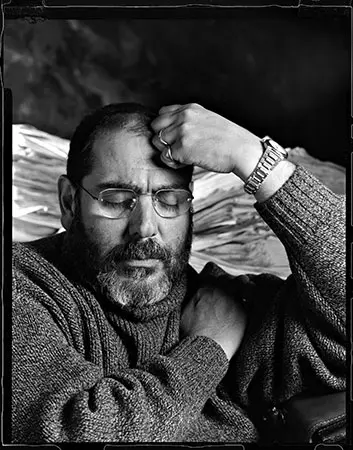
ObituaryNovember 19, 2015
Carlos Leppe
Carlos Leppe, an important figure in the Chilean art scene who in the 1970s introduced the country to a new way of making art, died in Santiago's Centenario Hospital last October 15th, from complications after a case of pancreatitis. Leppe studied Universidad de Chile's School of Fine Arts, organized happenings at Galería Central de Arte, and early on presented to a competition a key work for the development of his career: El perchero ("The Clothes Hanger"), where, using women's garments facilitated by Francisco Copello, another avant-garde performance artist, he undressed himself in the symbolic hanger of the dictatorship and its suppression of minorities. El perchero is now in the collection of the Reina Sofía museum in Madrid. Other essential works by Leppe are Cuerpo correccional ("Correctional Body"), with texts by Nelly Richard; Prueba de artista ("Artist's Proof"), with Marcelo Mellado, and his vibrant participation in Chile Vive ("Chile Lives"), a show curated by Justo Pastor Mellado at the Museo Nacional de Bellas Arte in 2000. There he presented Yo soy mi padre ("I Am Not My Father'), closing an entire cycle in his life. Afterwards, his work with the materiality of paint took he to different terrains, moving in the direction of art on TV. His most recent activity was as Chile's cultural attaché in Argentina and the preparation of a book on his work with his friend, the critic Justo Pastor Mellado. Leppe's work during the years of dictatorship formed alternative spaces outside the areas of control by the regime; one of them was the Visual Arts Workshop, manager by Cardinal Raúl Silva Henríquez, a defender of Human Rights. Leppe's performance Prueba de artista was presented there. This action marked his break with engraving and print-making, with all the study plans followed in the workshop, and with the pulchritude and mastery emanating from those presses, and his turn towards the urgent realities of what was happening in the country. Prueba de artista is concerned with human frailty, fears, and deficiencies, where the subject leaves aside all prejudices and enters the unexplored domain of fraternity in suffering. Another equally decisive work is Leppe's use of his own head in remembrance of Marcel Duchamp, with the drawing of a star on his skull reminding us of the detention camps in Chile during that period. Leppe propelled a shift in the ways of making art, from which there was no possible turning back. Many artists followed on his trail, a trail where all was permitted to counteract the closing of the country upon itself.