Art NotesSeptember 15, 2010
Carlos Enríquez: Painter of Ballads
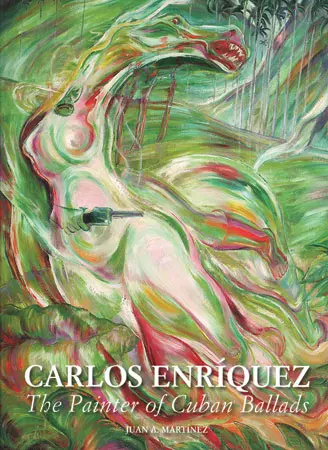
The 1930s of the Twentieth Century: imagine a rather short and slim man whose nerves keep him in constant movement. His black hair covered by a hat and dressed in sandals and clothes in the style worn by Russian peasants. Black eyes that gazed intensely and a large nose under which a moustache hid the mocking expression of his thin lips. This was the appearance of Carlos Enríquez (1900-1957), the controversial artist about whom Cuban-American writer Juan A. Martínez has written his latest book entitled Carlos Enríquez. The Painter of Cuban Ballads, published this year by Cernuda Arte. The Spanish word "romancero" is translated into English as a "collection of old Spanish ballads." A ballad is a poetic composition-originating in the north of Europe -that narrates legendary or traditional events with simplicity and melancholy. Romanticism found in the ballad a fitting form of expression, given the ballad's use of vocal¿narrative in nature¿and instrumental compositions that are not subjected formally to rigorously defined norms. Martínez needed to find parallels between the ballad as a poetic and musical form, and the work by the Cuban artist, who mythicized in his vast visual and literary production the narrations he formerly listened to as a child in his birthplace of Zulueta. Enríquez created archetypical characters inspired in the folklore and the history of Cuba, mainly from the rural areas. But he did not just develop myths that originated in Cuba and the Caribbean, as he also mythicized himself. Martínez's title for the book was inspired by the name of one of Enríquez¿ best-known series: El Romancero Criollo (The Creole Collection of Ballads). Enríquez died poor and nearly forgotten in his studio that he called El Hurón Azul (The Blue Ferret) in the outskirts of Havana. He left behind a wonderful collection of anecdotes that combine real and imaginary events But with the passing of time and the emergence of other generations of artists, this painter became just another of a group. One of the many qualities of this excellent book by Juan Martínez: through extensive research supported by a clever framework, Martínez has been able to reveal a contemporarily relevant and vivid Carlos Enríquez who could cross our path on the street, in a museum, or gallery at any given moment; drunk as always and seducing a woman at the opening of an exhibition. The stories in which he was involved¿ignored by many even within the art world¿ revealed to the critics, even the most astute, a complete identification between the work and the artist. He and pictorial and literary imaginary were one. Martínez found plenty of material associated with Enríquez; his artist statements; controversial articles; catalog texts; photographs, commentaries from his contemporaries; criticisms. Martínez searched in museums and private collections, following the scent of the artist's work. Based on this vast amount of researched material and on his personal take as a good art historian who specializes in Cuban modernism, Martínez was able to write a book that is now an essential read in the archives of Cuban culture. This book joins a vast bibliography authored by the Florida International University Art History professor, including the following: Art and National Identity: The Vanguardia Painters 1927-1950 (University Press of Florida, 1994); María Brito (Los Angeles: UCLA Chicano Studies Research Press, 2009), among others. Martínez's knowledge of the political and social aspects associated with modernist painting in Cuba from the 1930s is revealed in the pages written about Enríquez. Among other things, these pages also reveal the characteristics that define the ballad: legendary and traditional events; their narrative qualities, as well as a relaxed form not subjected to definitive rules. According to Martínez, Enríquez's creation is a version of the Romancero Gitano (Gypsy Ballads) written by Federico García-Lorca. Carlos would often change h...