Art NotesJuly 11, 2014
Carlos Cruz Diez, Maison de l’Amérique latine
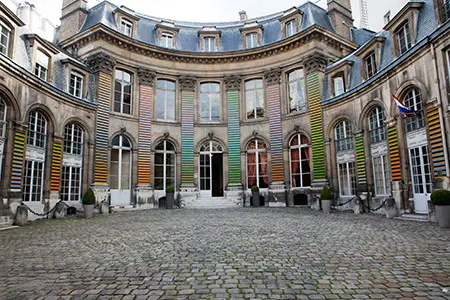
It is (almost) a young kid who just presented his memoirs and, at the same time, his most recent ephemeral installation in the oval courtyard of the Maison de l'Amerique latine in Paris. Combining the art of the word with the art of chromatic integration into architecture, Carlos Cruz Diez, born in 1923 in Caracas, brings forth the intense energy he carries inside with two events that precede nothing less than the Photography Month where he is slated to present (in the same location) unpublished, never exhibited works made in Venezuela before his relocation in France. Flanked by sociologist Jacques Leenhardt, Cruz Diez spoke of his youth in Caracas, of the difficulty of imposing a different concept of art in a context that did not favor change, and of his arrival in France. Answering joyfully and energetically the questions posed by Leendhardt, based on his biographical tome titled Vivir en arte. Recuerdos de lo que me acuerdo. (Fondation Cruz-Diez, Paris, 2014, 358 pp), the artist repetaedly affirmed the importance of his family both emotionally and professionally (his two sons and his daughter are in charge of the Atelier Cruz Diez), and how much he "loves people". Cruz Diez described the functioning of the Atelier, a place of research, encounter, collaboration and diffusion, as an "international of friends and family". Remembering the poor reception of his first exhibition in Caracas, in 1954, the artist justified his decision to become a designer and journalist in order to finance his work and to "be free". That unstable climate was his motivation to move to Europe, first to Barcelona and then to Paris, where he encountered a more open and questioning art scene that responded to his concerns regarding the relationship between art and life. Cruz Diez became joined the GRAV group, created his chromo-saturations at the Odeón metro station in 1968, and participated in the invention of new art discourse alongside other Latin American figures like Julio Le Parc and Jesús Soto. His temporary installation in the oval courtyard of Maison de L'Amerique latine was a veritable challenge, requiring the artist to confront the stylistic and architectural demands of an old space where stone masonry, large glass windows, and cobblestones, elements with which he needed to dialogue. Cruz Diez´s project is supported by 16 pillars, the only flat vertical portions of the walls that connect the windows in this Eighteenth Century courtyard. His work are 16 plasticized-paper panels attached directly to the stone, with eight different chromatic harmonies. The "large" ones measure 7,5 meters in height and 90 centimeters in width, the "medium-sized" panels are 4,9 meters tall and 65 cm wide; and the "small" ones are 2,7 meters tall and 65 cm wide. The verticality and horizontality of the lines, adde to their polychromy, are a dynamic response to this austere and very architecturally present space, providing a contemporary reading for it. The open courtyard of this hôtel particulier acquires a new life and the installation´s adaptation to the side (it´s plastic integration) is so precise in visual terms that one wishes for it to become permanent.