ExhibitionMarch 11, 2022
“Born of Informalism: Marta Minujín and The Nascent Body of Performance”
The Institute for Studies on Latin American Art (ISLAA) presents, until June 3, 2022, the exhibition “Born of Informalismo: Marta Minujín and the Nascent Body of Performance” curated by Michaëla de Lacaze Mohrmann. The third in a series of shows on Latin American modernism and its legacies, this show examines the early work of Marta Minujín (b.1943), tracing her trajectory from Informalist painting and sculpture to performance.
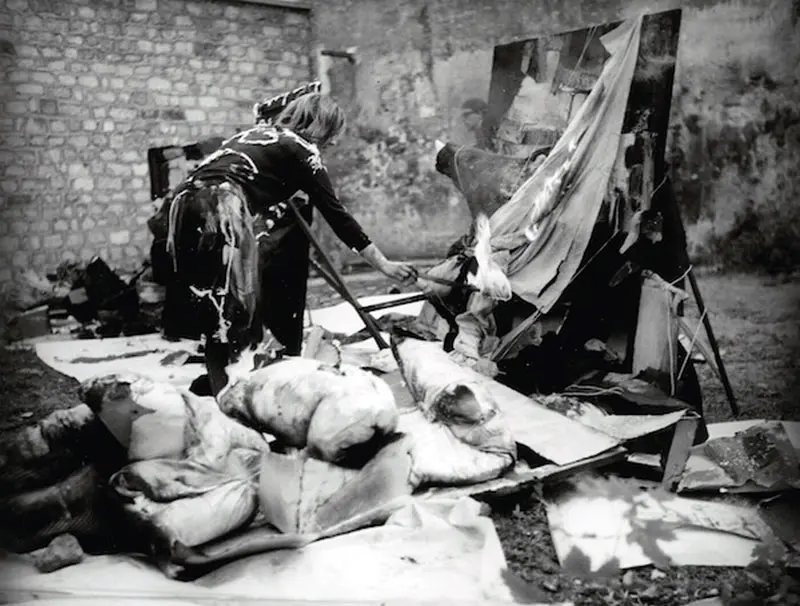
Featuring three of Minujín’s Informalist paintings made between 1959 and 1961 along with exhibition catalogs, photographs of sculptures, and documentation of the 1963 work “La destrucción,” this exhibition highlights “the importance of Informalism as a key conduit for Argentine experimental art of the 1960s. Whereas many accounts of the movement have focused on the production of a small contingent of male artists, this show encourages a reconsideration of its heterogeneity, transnational context, and sociopolitical framework through Minujín’s work, paving the way for additional research into its role in late twentieth-century Latin American art,” explains ISLAA.
Curator Michaëla de Lacaze Mohrmann explains, “Informalist painting emerged in the late 1940s as a form of expressive abstraction characterized by the gestural application of paint. Gradually taking root around the globe, the style developed across Europe, the Americas, and East Asia, pushing the approach in new directions. By 1956, it had firmly taken hold in Buenos Aires, where the movement’s proponents produced relief-like paintings that incorporated a somber color palette and the extra-artistic materials of everyday life, including rags and rusted cans. Evocative of the harsh realities of daily life and a general postwar malaise, Argentine Informalismo embraced ugliness, spontaneity, violence, and irrationality in a decisive break with the mathematically precise logic of the country’s preceding avant-gardes, such as Concretism.
While the style was largely dismissed by contemporary critics, who derided its use of base materials, Born of Informalismo highlights the movement’s art historical significance and role as a foundational catalyst for experiments beyond the canvas.”
Marta Minujín, who used Informalismo’s lexicon of earthy colors, found items, and textural impastos to convey the passage of time, style offered a crucial platform for testing out ideas regarding the body and action in art. Paintings such as “Great Stain” (ca. 1959), “Stain” (1960), and “Homage to Greco” (1961) reveal the effects of aging through their cracked skin-like surfaces. Minujín’s later informalist sculptures of the early 1960s marked a transition to three dimensions by constructing discarded mattresses and cardboard into fragile anthropomorphic forms.
These experiments in painting and sculpture coincided with Minujín’s early performances, paving the way for his first large-scale happening, “The Destruction,” a seminal work produced in Paris, in which she destroyed her sculptures in a ceremonial conflagration. Inspired by the Nouveaux réalisme in France and following the emergence of Arte Destructivo in Argentina, Minujín abandoned the informalist language in 1963, contributing formative work in installation, performance, and time-based media in the following years.
The exhibition is possible thanks to the support and collaboration of Marta Minujín and the Marta Minujín Archive, who generously made materials available for reproduction.
“Born of Informalism: Marta Minujín and The Nascent Body of Performance” is accompanied by a publication that includes an essay by Michaëla de Lacaze Mohrmann. Hard copies will be distributed free of charge at ISLAA and available for download online.
For more information: https://www.islaa.org/exhibitions/exhibition-2022-mar-born-of-informalismo
For RSVP: https://appointments.seesawmap.com/book/27925/
Featuring three of Minujín’s Informalist paintings made between 1959 and 1961 along with exhibition catalogs, photographs of sculptures, and documentation of the 1963 work “La destrucción,” this exhibition highlights “the importance of Informalism as a key conduit for Argentine experimental art of the 1960s. Whereas many accounts of the movement have focused on the production of a small contingent of male artists, this show encourages a reconsideration of its heterogeneity, transnational context, and sociopolitical framework through Minujín’s work, paving the way for additional research into its role in late twentieth-century Latin American art,” explains ISLAA.
Curator Michaëla de Lacaze Mohrmann explains, “Informalist painting emerged in the late 1940s as a form of expressive abstraction characterized by the gestural application of paint. Gradually taking root around the globe, the style developed across Europe, the Americas, and East Asia, pushing the approach in new directions. By 1956, it had firmly taken hold in Buenos Aires, where the movement’s proponents produced relief-like paintings that incorporated a somber color palette and the extra-artistic materials of everyday life, including rags and rusted cans. Evocative of the harsh realities of daily life and a general postwar malaise, Argentine Informalismo embraced ugliness, spontaneity, violence, and irrationality in a decisive break with the mathematically precise logic of the country’s preceding avant-gardes, such as Concretism.
While the style was largely dismissed by contemporary critics, who derided its use of base materials, Born of Informalismo highlights the movement’s art historical significance and role as a foundational catalyst for experiments beyond the canvas.”
Marta Minujín, who used Informalismo’s lexicon of earthy colors, found items, and textural impastos to convey the passage of time, style offered a crucial platform for testing out ideas regarding the body and action in art. Paintings such as “Great Stain” (ca. 1959), “Stain” (1960), and “Homage to Greco” (1961) reveal the effects of aging through their cracked skin-like surfaces. Minujín’s later informalist sculptures of the early 1960s marked a transition to three dimensions by constructing discarded mattresses and cardboard into fragile anthropomorphic forms.
These experiments in painting and sculpture coincided with Minujín’s early performances, paving the way for his first large-scale happening, “The Destruction,” a seminal work produced in Paris, in which she destroyed her sculptures in a ceremonial conflagration. Inspired by the Nouveaux réalisme in France and following the emergence of Arte Destructivo in Argentina, Minujín abandoned the informalist language in 1963, contributing formative work in installation, performance, and time-based media in the following years.
The exhibition is possible thanks to the support and collaboration of Marta Minujín and the Marta Minujín Archive, who generously made materials available for reproduction.
“Born of Informalism: Marta Minujín and The Nascent Body of Performance” is accompanied by a publication that includes an essay by Michaëla de Lacaze Mohrmann. Hard copies will be distributed free of charge at ISLAA and available for download online.
For more information: https://www.islaa.org/exhibitions/exhibition-2022-mar-born-of-informalismo
For RSVP: https://appointments.seesawmap.com/book/27925/