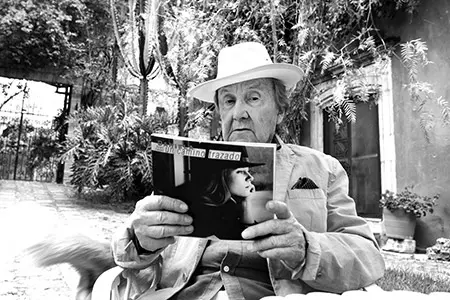
ObituaryJanuary 27, 2017
Bernard Chappard
Bernard Chappard was an influential collector, gallery owner and promoter of culture and the arts in Latin America. He stood out for his controversial, direct and irreverent (but exquisite) personality that made him the center of attention in conversations and social gatherings. His most important cultural contribution was the creation and direction of the Fundación Daniela Chappard, named in memory of his daughter, a photographer who died from AIDS in 1996. There, he was able to display his full potential defending the efficiency of the work of art as a mechanism against ignorance and in favor of activating awareness and social change. Bernard Chappard was born in 1930 in Paris, where the wars, the German occupation and persecution forced him to emigrate. In 1951, he arrived in Venezuela as the representative of a French champagne brand and his original one year stay plan became an entire life when he decided to settle down and form a family in the country. Early on he showed a passion for the visual arts and began to develop his important art collection. He initially focused on the small French masters, mostly from post-impressionism; but the lively colors, flavors, smells and joie de vivre that he found in the tropics—along with the freedom that seduced him to remain in Venezuela—also led him to collect Latin American works. His sharp gaze compelled him to search for "The" work and his drive kept him close both to the artistic production of consolidated masters as well as to the creativity of emerging artists, while somehow emphasizing abstraction and constructivism. The collection included an important group of Latin American artists like: Joaquín Torre-García, Gonzalo Fonseca, Francisco Matto, José Gurvich, Julio Alpuy, Armando Reverón, Francisco Narváez, Jesús Soto, Alejandro Otero, Cruz-Diez, Gego, Edgar Negret, Manuel Hernández, Carlos Rojas, Fernando Botero, Luis Caballero, Wifredo Lam, Rufino Tamayo, Francisco Toledo, Mira Schendel, Roberto Matta, and León Ferrari; as well as young creators from emerging and semi-established generations. The social gatherings organized in Chappard's residence elicited the fruitful exchange of ideas. The Fundación Daniela Chappard became the center of his interest. From there, he worked tirelessly for AIDS prevention and support for HIV positive persons, as well as for the promotion of art and photography from a perspective that approached artistic creation as a space to trigger reflections and disseminate information associated with the real effects and consequences of the illness, dismantling the prejudices and taboos connected to the theme. With the motto ART AIDS LIFE the foundation generated projects, publications and events like the Daniela Chappard Photography Biennial; the first of many auctions dedicated exclusively to photography—jointly organized with the Odalys Auction House—in support of the Extra Cámara magazine; and, in 2006, the exhibition of a selection of works from its collection at the Espacio Bellevue de Biarrits, in France. Under the title of "A Conquest of Latin American Art/Passion and Reason of a Constructive Spirit," Chappard presented a series of 133 works by essential masters of 20th century Latin American Art and more recent creators, under the supervision of Federica Palomero. The curatorship by María Elena Ramos included works by international masters like Le Corbusier, Serge Poliakoff, Victor Vasarely, Louise Nevelson or Basquiat –referenced in the collection. In 2008 the documentary by Tuki Jencquel titled Sin Ti Contigo (Without You With You) about the father/daughter relationship. In 2011, Chappard presented the book titled Más Allá del Sida la Vida (Life Beyond AIDS), which covered the history of the foundation...