ExhibitionNovember 12, 2021
Belkis Ayón (1967 - 1999)
The exhibition “Belkis Ayón. Collographs” will be on view from November 17, 2021, to April 18, 2022. Curated by Cristina Vives and organized in collaboration with Belkis Ayón Estate.
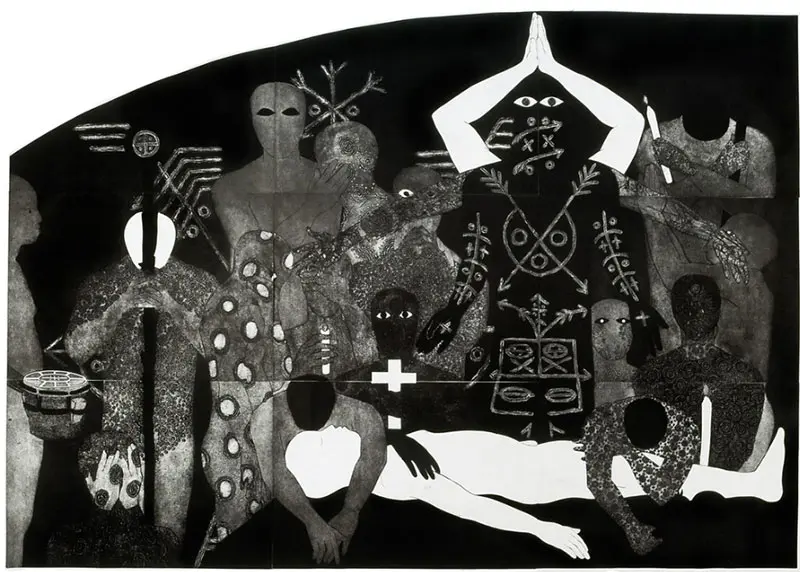
“Belkis Ayón. Collographs” is the first retrospective dedicated to the Cuban engraver Belkis Ayón (Havana, 1967-1999) in Europe. The exhibition includes a selection of around fifty collographs that delve deep into her short but prolific career, framing it inside the artistic and socio-cultural context of 1990s Cuba. It also highlights Ayón’s meticulous work process by exhibiting multiple matrixes of her prints, most of them previously unseen. Collography is an unusual printmaking technique based on matrixes built as collages and developed by Ayón to create a unique artistic language rich in nuances and textures that are hard to obtain through any other medium.
Ayón studied at Havana’s Instituto Superior de Arte de la Habana (ISA) and came of age as an artist during a profound economic and ideological crisis in Cuba triggered by the fall of the Iron Curtain in 1989 and the collapse of socialism in Europe. Her work shifted towards greater compositional monumentality and complexity, embracing the form of large-scale prints as spaces from which to address pressing issues in the 1990s: censorship, violence, intolerance, exclusion, inequalities, control mechanisms, power structures.
The exhibition approaches her work, starting with her first visual investigations around the Afro-Cuban secret society Abakuá, imagery that would accompany her from the time she submitted her thesis at the San Alejandro National Academy of Fine Arts in 1988. Then she worked on black-and-white prints in the 1990s, a more apt medium for expressing the existential turmoil that imbues her oeuvre. Her large-scale works with a pronounced set design quality, with a complex visual and universal world, are conveyed, syncretizing mythology and Abakuá ritual with the main iconographic elements of the Catholic religion.
Throughout her career, the rituals, and beliefs of the hermetic Abakuá brotherhood, exclusively reserved for men, served as an inspiration to create a singular language that expresses universal ethical, aesthetic, and ideological questions. The representation of the goddess Sikán, sacrificed by the men of her community and considered the artist’s alter ego, transcends the ethnic-identity or gender approach to address a complex universe of relationships, emotions, and conflicts such as regret, salvation, fear, and the need to transcend collective memory.
The series of prints Belkis Ayón made from 1997 onwards denotes the final work she would produce in a career tragically cut short by her suicide in 1999. In these final works — darker and more dramatic — space is pared down to circles with one foregrounded face that brings the spectator into a world of sharp conflict and profound existential angst.
“Belkis Ayón. Collographs” is the first retrospective dedicated to the Cuban engraver Belkis Ayón (Havana, 1967-1999) in Europe. The exhibition includes a selection of around fifty collographs that delve deep into her short but prolific career, framing it inside the artistic and socio-cultural context of 1990s Cuba. It also highlights Ayón’s meticulous work process by exhibiting multiple matrixes of her prints, most of them previously unseen. Collography is an unusual printmaking technique based on matrixes built as collages and developed by Ayón to create a unique artistic language rich in nuances and textures that are hard to obtain through any other medium.
Ayón studied at Havana’s Instituto Superior de Arte de la Habana (ISA) and came of age as an artist during a profound economic and ideological crisis in Cuba triggered by the fall of the Iron Curtain in 1989 and the collapse of socialism in Europe. Her work shifted towards greater compositional monumentality and complexity, embracing the form of large-scale prints as spaces from which to address pressing issues in the 1990s: censorship, violence, intolerance, exclusion, inequalities, control mechanisms, power structures.
The exhibition approaches her work, starting with her first visual investigations around the Afro-Cuban secret society Abakuá, imagery that would accompany her from the time she submitted her thesis at the San Alejandro National Academy of Fine Arts in 1988. Then she worked on black-and-white prints in the 1990s, a more apt medium for expressing the existential turmoil that imbues her oeuvre. Her large-scale works with a pronounced set design quality, with a complex visual and universal world, are conveyed, syncretizing mythology and Abakuá ritual with the main iconographic elements of the Catholic religion.
Throughout her career, the rituals, and beliefs of the hermetic Abakuá brotherhood, exclusively reserved for men, served as an inspiration to create a singular language that expresses universal ethical, aesthetic, and ideological questions. The representation of the goddess Sikán, sacrificed by the men of her community and considered the artist’s alter ego, transcends the ethnic-identity or gender approach to address a complex universe of relationships, emotions, and conflicts such as regret, salvation, fear, and the need to transcend collective memory.
The series of prints Belkis Ayón made from 1997 onwards denotes the final work she would produce in a career tragically cut short by her suicide in 1999. In these final works — darker and more dramatic — space is pared down to circles with one foregrounded face that brings the spectator into a world of sharp conflict and profound existential angst.