Art NotesAugust 26, 2011
ARTenOtraparte
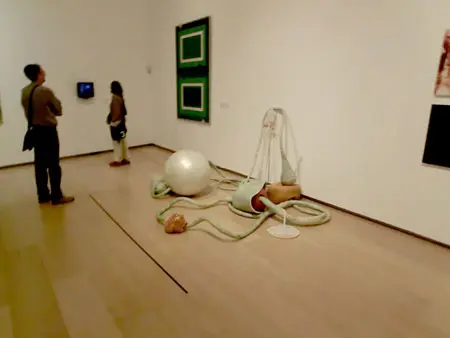
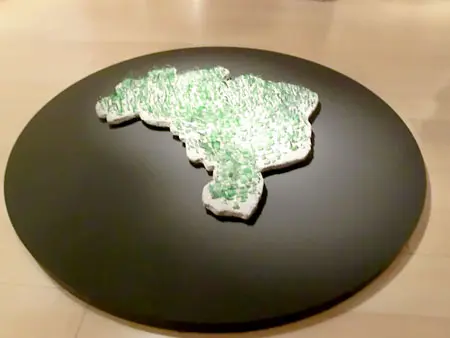
Brazil's success in this era of the image stems from the success of the themes the country has been coining for half a century or longer. Such success has made Brazil the leading country when it comes to a tropical modernity represented by the contrast between the utopic Brasilia of Lucio Costa and Oscar Niemeyer and the delirious baroque of the Carnival groups from Rio de Janeiro, the forest of skyscrapers in São Paulo and the endless beaches in Copacabana; the exuberant beauty of the mulatas and the anorexic ways of Brazilian top models; the wild Maracaná and equally wild favelas. In sum-and I am not sure it is possible to summarize in this instance -it is all about excess and the rationalization of excess. And it is this tumultuous and explosive combination of elements that transpired in the contemporary Brazilian art exhibition that took place from May through July of this year at the IVAM in Valencia, Spain. The very title of the exhibition, "A Giant by Thine Own Nature," invokes another attribute indelible to the notion that exemplifies such tropical modernity: Brazil's enormous size. Although the exhibition cannot possibly match the country¿s actual enormity, it is sufficiently heterogeneous to convey the enormous diversity of aesthetic alternatives and proposals that are today part of the country¿s artistic scene and continent. Thus the presence of the hard and pure conceptualism of the videos Barulho de Fundo (São Paulo Biennial, 2006) by Renata Lucas, A Arte é Futebol Sem Bola (2004) by Lula Wanderley, Menarca (2007) by Katie Van Scherpenberg; and Testemunhas Oculares X, Y e Z (1997), an early installation by Adriana Varejao that reflects on portraiture, the pose, stereotypes, and the gaze. Conversely, there is also the "more activist than conceptual" conceptualism impeccably exemplified in the installation entitled Value Impaired (1988) by Cildo Meireles; or in Mapa Mudo (Silent Map, 1979), a powerful sculpture by Ivens Machado in which the map of Brazil created in reinforced concrete appears bristling with broken bottles. The fascinating tropical paradise can also be tremendously hostile. Neo-Baroque-or simply the imaginative and recurrent baroque that has always existed-is represented in the work entitled Arrumação (2009), a porcelain sculpture-collage by Barrào, as well as in the colorful site-specific mural paintings that Pedro Varela created expressly for this exhibition along corridors, landings, and stairways that connect the various spaces within the museum. This multifaceted and prolific vein from the Brazilian culture also includes works like I Love You (2000), an installation by Ana Miguel that extrapolates and subtly eroticizes the image of a bed with a canopy; Sem Título (Untitled, 2010) by Maria Nepomuceno, a large format-biomorphic and winding-ceramic sculpture created with braided straw, rope, and beads that equally rare and attractive; and Mientras Estamos Aquí (While We Are Here, 2008), a large sculpture shaped like a small domed enclosure by Ernesto Neto, with transparent elastic mesh walls tensed by polished wood pieces evoking of a dinosaur's skeleton. It would also be possible to include as part of this segment of works the piece by Vik Muniz entitled Self Portrait as Drowned Man, After Hyppolyte Bayard (1870 (2004) that, despite having the emphasis on the idea that characterizes conceptualism, it also has the strident colors and formal agglomeration of baroque. The surrealist-or rather Victorian-fantasy is represented by El Pavo Misterioso (The Mysterious Turkey, 2009), a painting by Os Gêmeos. Likewise, naivety can be found in the polyptych Paisagem Imaginante (circa 1954). The vindication of the ancestral and colonial legacies is present in Portais and Bendeirinhas (circa 1960) by Volpi; the sarcastic pieces Miss Brasil (undated) and Miss Espanha (undated) by Bispo do Rosário; Aventuras do Poeta Edi Simons (1994) painted curtains by Cabelo; and in the splendid installation entitled ...
Gallery