Book ReviewsApril 5, 2024· By Carmen Di Pasquale
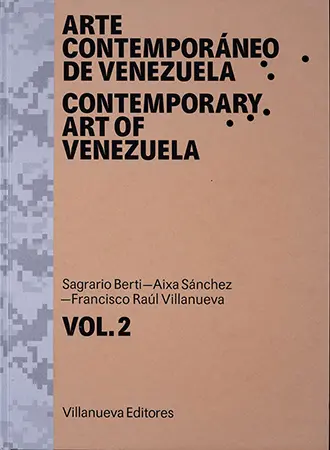
Arte contemporáneo en Venezuela, Vol. 2
The second volume of Arte contemporáneo en Venezuela (Contemporary Art in Venezuela) was launched in January and December 2023 in Madrid and Caracas respectively, as a sequel to the first one, issued in 2006 by the same publishing house. For each volume, twenty-seven artists who belong to one of two periods close to current events—and who are, in Villanueva's words, “among the main protagonists of the most recent generation of emerging artists”—were chosen to represent “the contemporary.”
Any historiographical tracing of artistic practices in Venezuela since the first decade of 2000, and even more so if from a private initiative, must assume a place of enunciation marked by an overflow. Lacking a museum system capable of setting in motion the complex mechanism of construction of meaning (which begins in curated acquisitions followed by systematic reception, preservation, and activation through exhibitions), the continuous recording of generations of “contemporary” artists in Venezuela has been unmoored from the established features of the “national.” As promoters and researchers, the editors have recognized this state of affairs and the inevitable tension arising between the need to give continuity to art historiography with the overflow of private initiative and the national state-run museums’ suspension of their historiographic responsibility.
This acknowledged tension led to the series of critical essays in the second volume of Arte contemporáneo en Venezuela, which account not only for the difficulties of this historiographic task, but also for the simultaneous need to record the vitality, and marginality, of the country’s visual practices. This is underscored in an interesting section under the title “Institutions and art projects in Venezuela,” which highlights the role of private spaces and the current burden of the public ones.
Some essays were written abroad and others from within, reflecting the extended condition of both artistic practices and corresponding reflections, given the extraterritorial condition of a large part of the national population. Curator and researcher Cecilia Fajardo-Hill recognizes, from abroad, how difficult it is to get a global or panoramic idea of contemporary artistic practices in Venezuela, and prefers to focus on that which is fragmentary—“provisional, unstable, non-linear, and unpredictable”—as an image that emerges from the group of artists and works gathered in this publication. This essay prologues the book rather briefly, but with interesting postulates arising from her dialogue with Ruth Auerbach, a researcher based in Venezuela.
The following text, signed by all three editors, offers an account of the criteria guiding the selection of the artists and their inscriptions in this cartography, which fuses “history,” “the contemporary,” and Venezuela. They explain that “this new volume has been conceived in order to incorporate into the historiography of Venezuelan art some of the new names, which according to a group of experts should be considered among the most relevant.” Anticipating the controversy that may arise in this attempt to construct a historiography vis-a-vis the state’s institutional absence, the editors tried to clarify as much as possible, and in an honest way, which criteria have directed their difficult task. In order to entwine the current selection with that of the first volume, they asked researchers connected to contemporary and emerging artistic practices of the chosen periods to compose a list, which was then compared with the others. Likewise, they fully understand the need to reflect on the delocalized identity of Venezuelan artistic practices. The content structure of the book presented in this introductory essay offers, in addition to the critical essays, the alphabetical arrangement of the chosen artists on two double spreads accompanied by brief reviews written by a researcher close to each creator, as well as the technical captions of the illustrated works, generously displayed on double spreads with the typographic and visual mastery of Caracas-based VACA design studio (Gabriela Fontanillas and Álvaro Sotillo), and impeccable printing and binding by Barcelona-based Syl L'art Grafic.
Two other essays fall into this assumed game of tensions and fragilities inherent to today’s diverse, dynamic, and diffuse art practices from Venezuela. One is by Ruth Auerbach, who undertook an “itinerary through some of the most relevant circumstances that have conditioned the country’s art scene” in an attempt to broaden the concept of artistic production during the political period of the so-called “revolution.” And the other one, written from Lima by Fabiola Arroyo, focuses on the diaspora of Venezuelan artists, cultural managers, and curators, which to a great extent defines or marks the period registered in Arte contemporáneo en Venezuela, Vol. 2.
Any historiographical tracing of artistic practices in Venezuela since the first decade of 2000, and even more so if from a private initiative, must assume a place of enunciation marked by an overflow. Lacking a museum system capable of setting in motion the complex mechanism of construction of meaning (which begins in curated acquisitions followed by systematic reception, preservation, and activation through exhibitions), the continuous recording of generations of “contemporary” artists in Venezuela has been unmoored from the established features of the “national.” As promoters and researchers, the editors have recognized this state of affairs and the inevitable tension arising between the need to give continuity to art historiography with the overflow of private initiative and the national state-run museums’ suspension of their historiographic responsibility.
This acknowledged tension led to the series of critical essays in the second volume of Arte contemporáneo en Venezuela, which account not only for the difficulties of this historiographic task, but also for the simultaneous need to record the vitality, and marginality, of the country’s visual practices. This is underscored in an interesting section under the title “Institutions and art projects in Venezuela,” which highlights the role of private spaces and the current burden of the public ones.
Some essays were written abroad and others from within, reflecting the extended condition of both artistic practices and corresponding reflections, given the extraterritorial condition of a large part of the national population. Curator and researcher Cecilia Fajardo-Hill recognizes, from abroad, how difficult it is to get a global or panoramic idea of contemporary artistic practices in Venezuela, and prefers to focus on that which is fragmentary—“provisional, unstable, non-linear, and unpredictable”—as an image that emerges from the group of artists and works gathered in this publication. This essay prologues the book rather briefly, but with interesting postulates arising from her dialogue with Ruth Auerbach, a researcher based in Venezuela.
The following text, signed by all three editors, offers an account of the criteria guiding the selection of the artists and their inscriptions in this cartography, which fuses “history,” “the contemporary,” and Venezuela. They explain that “this new volume has been conceived in order to incorporate into the historiography of Venezuelan art some of the new names, which according to a group of experts should be considered among the most relevant.” Anticipating the controversy that may arise in this attempt to construct a historiography vis-a-vis the state’s institutional absence, the editors tried to clarify as much as possible, and in an honest way, which criteria have directed their difficult task. In order to entwine the current selection with that of the first volume, they asked researchers connected to contemporary and emerging artistic practices of the chosen periods to compose a list, which was then compared with the others. Likewise, they fully understand the need to reflect on the delocalized identity of Venezuelan artistic practices. The content structure of the book presented in this introductory essay offers, in addition to the critical essays, the alphabetical arrangement of the chosen artists on two double spreads accompanied by brief reviews written by a researcher close to each creator, as well as the technical captions of the illustrated works, generously displayed on double spreads with the typographic and visual mastery of Caracas-based VACA design studio (Gabriela Fontanillas and Álvaro Sotillo), and impeccable printing and binding by Barcelona-based Syl L'art Grafic.
Two other essays fall into this assumed game of tensions and fragilities inherent to today’s diverse, dynamic, and diffuse art practices from Venezuela. One is by Ruth Auerbach, who undertook an “itinerary through some of the most relevant circumstances that have conditioned the country’s art scene” in an attempt to broaden the concept of artistic production during the political period of the so-called “revolution.” And the other one, written from Lima by Fabiola Arroyo, focuses on the diaspora of Venezuelan artists, cultural managers, and curators, which to a great extent defines or marks the period registered in Arte contemporáneo en Venezuela, Vol. 2.