Chilean Art in Venezuela
The most recent exhibition presented by the CAF-Banco de Desarrollo de América Latina in its Caracas headquarters, Chilean Art in Venezuela gives continuity to the program of support for the Latin American visual arts. The exhibition consists of thirty-four pieces created by a prominent group of Chilean artists.
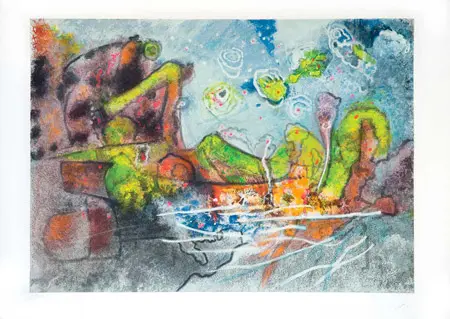
On this occasion, the curatorial work as well as the museography was performed by Mariela Provenzali, who organized the exhibition by finding agreements and contrasts amid the thematic and formal diversity of the proposals included in the show. Leading the exhibition is the work by Roberto Matta. Even as the pieces by Matta are chronologically distant from the emblematic surrealist period he shared with Masson, Miró, Dalí and others, they nonetheless express the artist's imaginary and share the chromatic force of his paintings from the 1940s and 1950s. Other renowned creators that are present in the exhibition include: Nemesio Antúnez, José Balmes, Raúl Valdivieso, Ricardo Yrarrázaval and Rodolfo Opazo.
While the work by Antúnez reflects the influence of Pop Art, Balmes's, through the rationed use of visual resources, expresses the power of informalism in quasi-minimalist pieces. For his part, Valdivieso focuses on the rigor of classic sculpture from a contemporary approach and Yrarrázaval shows images that reflect his continuous exploration centered on human beings out of context and isolated from their surroundings. The work by Opazo, another prominent artist from Chile, depicts enigmatic forms and situations close to Surrealism. The work by Mario Toral completes the proposals from this group with nudes that are sometimes suggestive and other times unequivocal. About this, Toral has said that "human beings in the nude are timeless; they can be placed in situations that can be anguishing, sensual, ecstatic, painful…" Other artists include Benito Rojo and from his abstract phase, Jorge Tacla with his gestural and dematerialized landscapes; Arturo Duclos with pieces that rely on symbols and images reinterpreted from the conceptual dimension; and a piece by Marcela Krause, a follower of informalist matteric painting.
Particularly meaningful in the Venezuelan context are the works of four artists that are also part of the exhibition: Armando Lira, Héctor Villalobos, Dámaso Orgaz and Aníbal Ortizpozo. Lira arrived in Venezuela during the 1940s and became a great teacher for a young generation of artists who at the time were commencing their artistic careers at the Escuela de Artes y Oficios; his landscapes of the time represent a loyal reflection of the so called "Escuela de Caracas." Villalobos discovered in the blue territory of Venezuela the light and colors of the tropics that he expressed through intensive and festive works; Ortizopo, on the other hand, nationalized Venezuelan since the 1970s and after having delved into works centered on social issues, he presents us with works that share many things with Abstract Expressionism.
The exhibition is complemented with a catalog of images of the works and text by researcher, art critic and curator, Susana Benko.