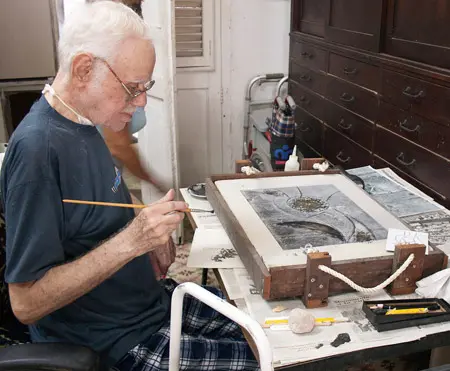
Antonio Vidal-Fernández
A circle integrated into the composition would oftentimes become the author's distinctive mark. So, anyone looking at one of his paintings would almost always be able to identify it as one of Antonio Vidal's work, even without having to look at the signature. It was rare for the artist not to include a stain or geometric shape on the canvas or paper. Whether centered or on any area of the composition, the circle was a recurrent presence in the work of this artist from Havana who, since the 1950s signed a tacit pack of loyalty toward abstraction. Like an abstract Monet, Vidal survived for a longtime the rupture of Los Once (1953-1955), an emblematic group that contributed to the union between Cuban art and the mainstream international for the first time in the island's history.
A master of composition, Vidal was not afraid to repeat himself nor did he search for ways to do so. He experimented with reliefs and textures through collage, matteric painting and impasto. He delved into free-standing sculpture in metal; Vidal painted on match boxes that allowed him to put together several spatial proposals. On paper, he also left a stamp of his written poetry and his interest in literature. But not even then was his work ever literal.
He illustrated books, enjoyed good literary works and intelligent conversations accompanied by coffee, cigarettes, a penetrating gaze (two black points surrounded by blue), deliberate pauses and a subtle irony that expected, at the very least, a smile as a sign of understanding or complicity.
Vidal's secluded lifestyle away from the social buzz did not stop him from enjoying interacting with others. Thus, for many years he taught at the Escuela Nacional de Arte, and would welcome in his modest home—overpopulated with papers and paintings—anyone interested in his work and knowledge. He did not mind sharing an exhibition with emerging creators—who represented a new generation of Cuban abstract artists—without the hierarchic barriers that his status as a Master and National Visual Arts Prize recipient entitled him to. During the last years of his life, Vidal attended inaugurations and tributes in a wheelchair pushed by Gladys, his wife and other love besides abstraction. All these activities made him feel younger and gave him new energy.
He was always seduced by the interaction with others, perhaps because of his previous experience in the field of advertising and environmental design. Many Cubans have seen his works on the street without recognizing the author, as those pieces are not signed or boast the already mentioned circle. It was Vidal himself who told me that the logo of the Inclán store—located in the lobby of the building where we have been living for the last thirty years—was designed by him. Since that revelation, I look at my habitual surroundings in a completely different manner, as now I see it qualified by Vidal's marks that I see—and that remind me of him—almost every day."