ExhibitionApril 11, 2014
Antonio Dias at the Fundación Iberê Camargo
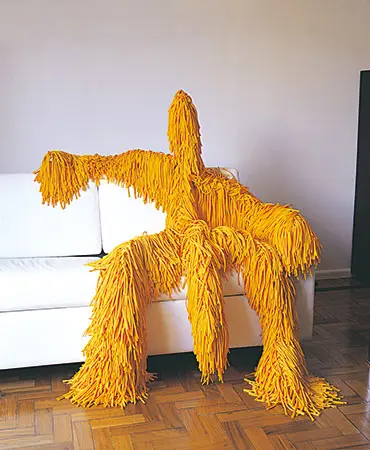
An important exhibition titled Power of Painting by artist Antonio Dias was inaugurated in March of this year at the Fundación Iberê Camargo in the Brazilian city of Porto Alegra, in Rio Grande do Sul. An artist with a prominent artistic trajectory in Brazil and associated with the vanguard of the 1970s, Antonio Dias participated in historic exhibitions that marked the return of figuration—along with its critical and political dimensions influenced by the Pop Art and New Realism contexts—such as Opinion 65, Opinion 66 and New Brazilian Objectivity, all presented at the Museu de Arte Moderna do Rio de Janeiro—a relevant space for the events in contemporary art of that historic time. Curated by Paulo Sergio Duarte, the exhibition by Dias at the Fundación Iberê Camargo consists of 28 works created between 1999 and 2011—with Dias's paintings from the last thirteen years serving as the central focus. There are also objects and installations that reveal to the visiting public a rich artistic language where engraving, printing techniques and photography appear as prominent expressive mediums, along with the performances and videos that he also used in his artistic practice. The exhibition spans two floors of the building designed by Portuguese architect Álvaro Sisa-Vieira. Once in the atrium by the foundation's entrance, the public encounters works like Seu Marido (Her Husband, 2002), a life-size mannequin created with soft drink cans covered with yellow spandex that imitates hair; and the painting História Resumida para Crianças (Abridged History for Children, 2005). Both works announce the type of works that viewers will encounter ahead. The period in which Antonio Dias began his artistic trajectory included the events associated with the presence of the military dictatorship in Brazil's political life, but it was also a time of transformations of the language of art, or rich cultural events and debates, even with all of the censorship and restrictions to freedom. In 1968, the year the dictatorship tightened its grip, Antonio Dias moved to Milan, Italy, where he has a studio to this day. During that period, Dias had an intense interaction with the European and US art scenes. He began pioneering research in the field of conceptual art, as he explored the relationship between words and images. He participated in avant-garde art exhibitions in several countries across Europe, the US and Japan. He also lived in Germany for a while as result of a artistic fellowship granted by DAAD. Nonetheless, he continued to be involved in the Brazilian art scene by participating in important solo and group exhibitions at museums and art galleries, and also by taking part in biennials. His work is part of several museum and private collections. About the exhibition Dias had this to say: "It is an exhibition that I hope reflects what I have been working on in recent years. I seldom have the opportunity of having four or five recent works in my studio at the same time. Sometimes, when I want to spend more time with a particular work, I need to hide it in another studio so I can think about the things that such work is proposing to me… Also see article published in issue 92 of ArtNexus magazine, page 34