ExhibitionMarch 8, 2010
Ana María Salas: Frente al Espejo, Diario 2002-2005
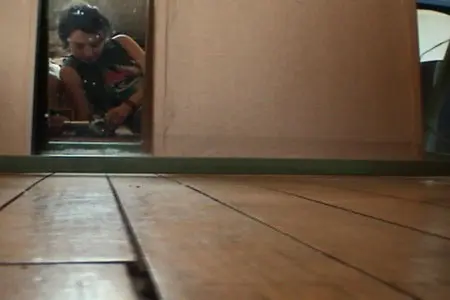
A year ago, the Mundo Gallery organized a collective exhibition entitled Historias Íntimas (Intimate Stories). Among the participating artists, in the main female painters, was Ana María Salas with her video-installation Reflejos (Reflections). The 30-minute video presents an intimate diary that led to her first film called Frente al Espejo, Diario 2002-2005 (Before the Mirror, 2002¿2005). The opening of her opera prima took place in France on November 21 at the Commune Image International Student Documentary Film Festival, in Saint-Ouen, and later in Colombia at the Festival de Cine y Video de Santafé de Antioquía (Santafé de Antioquía Film and Video Festival). There was also another screening organized by the El Perro Que Ladra Collective at the La Fémis film school in Paris, and a film opening is planned in Bogotá this year. The intimate diary has a long historic connection with writing. In The Golden Notebook, a large book that won its author the Nobel Prize, Doris Lessing addresses in depth the theme of writing an intimate diary. Diaries by female writers such as Katherine Mansfield, Virginia Woolf, Anaïs Nin, and Alejandra Pizarnik, to mention a few, have been published, among other reasons, because of their literary value. To keep a diary with a video camera is something that even today is a little unusual, and it is a clever gesture to desire to turn it into a movie. According to Salas, "The decision to make a video implied asking myself for its specificity when compared to my personal diaries (which I regularly keep from childhood). From the beginning, I assumed this practice as a constant exploration of the audiovisual language through which I want to express a feeling, a particular sensation, the state of mind in which I find myself at the moment of the recording, with the image, the direct sound, the camera movements, what is seen and is not seen in the images. I have always wanted to avoid words, the spoken language." The capturing of her emotional states is achieved through several resources and time periods. To do so, it is sufficient for the camera to register a flood of light on a wall; on another occasion, the take of two beautiful roses may suffice, while one of Gardel¿s harmonious sounds is heard in the background; also sufficient is a dash of light revealing on the mirror the act of recording oneself on camera, and on another occasion, only a brief, dark take with the sounds of a song. Other sequences are more complex. For instance, when Salas is engaged in a conversation with her mother about her projects and her life desires, or when she appears to caress everyday objects with the camera as its lens finally settles on a window, capturing a really blue sky with pink clouds, focusing on a part of the moon as an airplane seemingly passes it through precisely at that moment. The camera remains focused on the sky and the airplane disappears; now there are only the moon and the cut. Both in the very brief episodes as well as in the longest ones, an affective moment is being captured, a profoundly intimate moment. The difference between Reflejos and the movie goes beyond their duration. The former reminds us of impressionist paintings, loose strokes that construct a whole light flooding on all the objects, fragments of intimacy that are part of a diary. In the latter, longer, version, Salas is able to outline a story by relying on these same fragments. It represents a more careful version that reveals a woman who evolves. These fragmentary forms are united through the gaze and experience acquired during the making of the film. It is a diary that unfolds on itself, a sort of self-reflection. And precisely as occurs with the author, the spectator is connected to his/her own intimacy through the story.