ExhibitionSeptember 25, 2019
America Weaves at The Coral Gables Museum
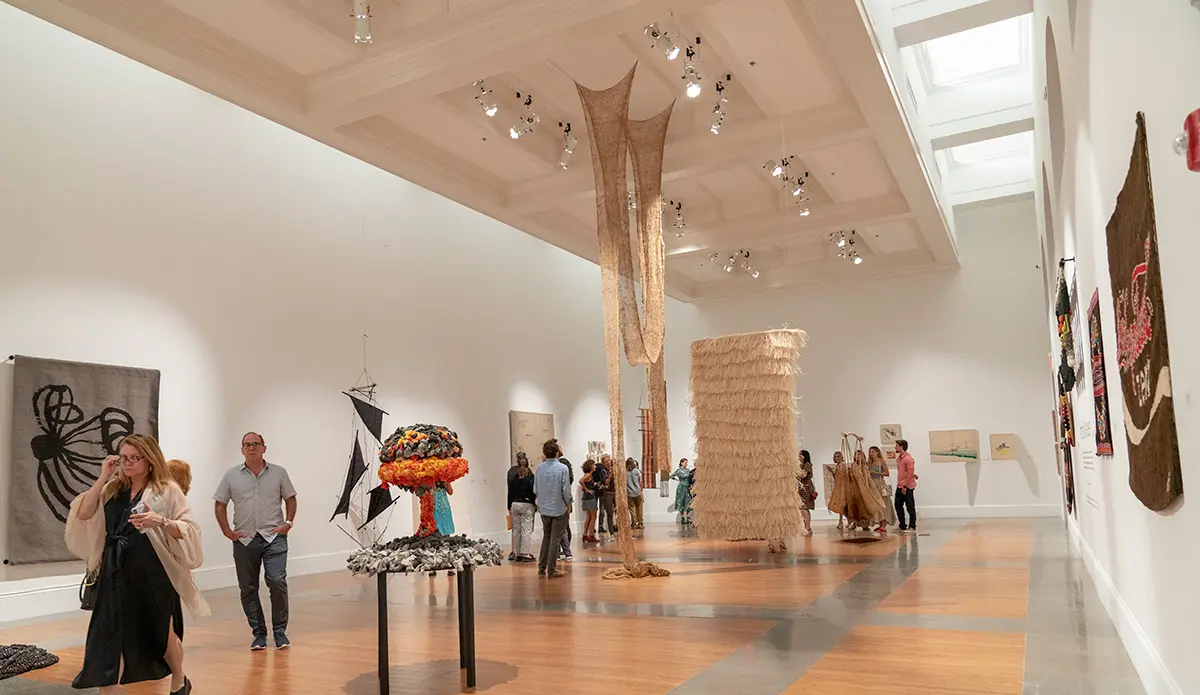
The Coral Gables Museum is presenting until November 1, 2019 the exhibition America Weaves. Curated by Adriana Herrera the show gathers artists who expand the borders and possibilities of art with their textile work. Featuring creators from Argentina to the United States, this exhibition proves that America has been a privileged space for the creation of contemporary textile art. Artists in the show interweave not only materials, but also the past and the present, forwarding visions of the world and ways to account for it.
The Latin term texere is the root of the Spanish word “tejer” (to weave). It is also connected with the action of interlacing or weaving and originated other key terms related to textile art such as text, hypertext and context. The wide range of labor and the different materials of the works refer to this vast history and meanings. Artists not only weave threads, cloths and fabric, but also metal—a technique partly nurtured by the legacy of native cultures.
The exhibition includes works as Amazonnia, 2004 by Jorge Eduardo Eielson (Peru, 1924—Italy, 2006), a late work by the experimental poet and contemporary art; Crear en la expansión, 1986, by Álvaro Gómez Campuzano (Colombia, 1956), one of the first works in a series that he has developed for three decades; Dibujo No 7, 1978, by Gego (Gertrude Goldsmith, Germany, 1912-Venezuela, 1994) made of assembled or interwoven steel wire. The double-faced work Eclipse solar, 1980, is made by the also pioneer Stella Bernal de Parra (Colombia, 1933), who is part of a generation of women formed in Bogotá, Colombia under the influence of Bauhaus. Untitled (La tira), by María Angélica Medina (Colombia, 1939) —a strip woven with cabuya or pita rope.
The remaining works included in America Weaves have been developed during the last decade. The photograph by Tatiana Blass, Penélope, 2011, also documents an intervention and performance in a landscape. Several of the artists in the show use textile techniques such as embroidery and/or hand-sewn appliqués in order to rewrite history and to deconstruct narratives. The Guerra de la Paz Collective approaches contemporary reality in its iconic work Atomic, 2009, made with secondhand clothing. It is a call to take shelter from the irrational violence that threatens humanity. In Migración y delirio, 2019, Juan José Olavarría lays out a map that evokes the silhouette of Latin America with a very personal embroidery style. He uses a piece of cloth intervened with blood and dust as a metaphor of the traces of those forced to leave their homelands.
The Latin term texere is the root of the Spanish word “tejer” (to weave). It is also connected with the action of interlacing or weaving and originated other key terms related to textile art such as text, hypertext and context. The wide range of labor and the different materials of the works refer to this vast history and meanings. Artists not only weave threads, cloths and fabric, but also metal—a technique partly nurtured by the legacy of native cultures.
The exhibition includes works as Amazonnia, 2004 by Jorge Eduardo Eielson (Peru, 1924—Italy, 2006), a late work by the experimental poet and contemporary art; Crear en la expansión, 1986, by Álvaro Gómez Campuzano (Colombia, 1956), one of the first works in a series that he has developed for three decades; Dibujo No 7, 1978, by Gego (Gertrude Goldsmith, Germany, 1912-Venezuela, 1994) made of assembled or interwoven steel wire. The double-faced work Eclipse solar, 1980, is made by the also pioneer Stella Bernal de Parra (Colombia, 1933), who is part of a generation of women formed in Bogotá, Colombia under the influence of Bauhaus. Untitled (La tira), by María Angélica Medina (Colombia, 1939) —a strip woven with cabuya or pita rope.
The remaining works included in America Weaves have been developed during the last decade. The photograph by Tatiana Blass, Penélope, 2011, also documents an intervention and performance in a landscape. Several of the artists in the show use textile techniques such as embroidery and/or hand-sewn appliqués in order to rewrite history and to deconstruct narratives. The Guerra de la Paz Collective approaches contemporary reality in its iconic work Atomic, 2009, made with secondhand clothing. It is a call to take shelter from the irrational violence that threatens humanity. In Migración y delirio, 2019, Juan José Olavarría lays out a map that evokes the silhouette of Latin America with a very personal embroidery style. He uses a piece of cloth intervened with blood and dust as a metaphor of the traces of those forced to leave their homelands.