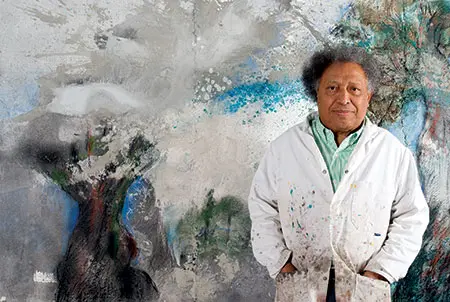
ObituaryOctober 28, 2015
Alirio Palacios
Alirio Palacios, artist, good friend, and teacher, died in Caracas last September. He leaves behind an immense legacy; everything in his work, from his drawings and engravings to his paintings and sculptures, was conceived in monumental, challenging ways, with the firm desire to go beyond the boundaries imposed by the media in which he worked. And perhaps this is one of his teachings. Alirio was never content with doing just a little, or to keep to the mean. Not even during his formative years. In fact, from early on he had internalized nature's outsize boldness and strength. He was born with it, he carried the memory with him everywhere, and he acted creatively in consequence. This is why, already in his early mezzotints, the color black used was the blackest, as he was searching the deepest depth, the most profound. Like all the times when he experienced absolute darkness in his native Delta region. In those dark nights, trying to tame his fear, sounds were also more intense and looming: the river, the rain, the cries of animals and insects, and also, one must remember, the voices of his ancestors. All of this was engraved for him. And so, from the depth of blackness, in the midst of chiaroscuros and fade-outs, figures appear gradually and move towards light, Alirio's strength has been, precisely, not to fall for foreign provocations, fashions, or trends. His education was rigorous, and that was his own decision. Early on he had the vision and foresight to make important decisions that changed the path of his formative processes. Thus, when he noted that academic teaching in Caracas and Rome were limited to the reproduction of models in plaster, he resigned his scholarship and went to China in search of greater spiritual fortitude for his work. He lived in China between 1961 and 1966, studying drawing and engraving at Beijing University. There he attained the discipline he had not been able to find in Western schools: he learned to dominate the forms of nature and to reinterpret them on the basis of memory, as he put them to paper. Returning to Caracas in 1966, Alirio devoted himself to painting. He was to remain in the Venezuelan capital for only two years, however. The city's cosmopolitanism and the kinetic art boom were a cultural shock for him. Being a searcher after myths, he realized that the Delta region and China were closer to him, spiritually, than the modern, progressive city. Between 1965 and 1970 he studied in Warsaw, feeling at home with what the Polish city's culture had to offer. There he discovered graphic design and became interested in applying his drawing technique to the creation of posters. Meanwhile, he painted his world of wakefulness, dreams, obsessions, and ghosts. In Geneva and Cracow, between 1972 and 1975, Alirio continued his study of engraving, thus closing his formative period. At that point he felt he had mastered the medium, and decided to return to Caracas, where his experience and professionalism granted him a position in the graphics team of the National Cultural Council and as Director of the National Culture Journal. He continued to paint throughout this period. Later, in 1985, he was named cultural advisor to the Venezuelan Consulate in New York. He set up his studio in SoHo, and alternated between NYC and Caracas ever since. The Delta region's past continued to drive him. It was this, perhaps, what gave him the titanic strength needed for the large-scale works that came afterwards: his concretegraphs, reinforced concrete planks that, besides being used for engraving, are works of art in themselves; xylographs intervened as unique items; prints using the glycée technique. He painted and engraved figures, landscapes, and, of course, horses. Lin Ku Lin's horse, painted 600 years ago and the topic of his dissertation in Beijing, was a matter for detailed ...