Art NotesMay 13, 2016
Aimée García
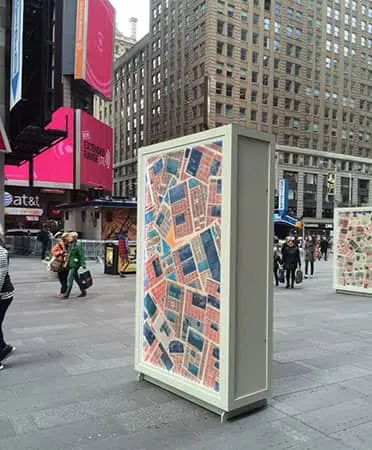
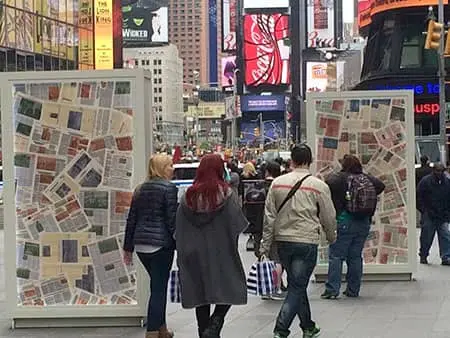
Aimée García, who belongs to a generation of Cuban artists who have been described as cynical, knows about ego and aura, but also about efficiency and instrumentality. She knows the difference between the aseptic sheen of a gallery or a museum, and the ferment and the contamination of the public stage. Invited by the Cuban Artists Fund to develop a public intervention in Times Square, she knew very well that her proposal, no matter how megalomaniac, could never become hegemonic over the fascination and the high visual voltage of that confluence of corners. Yet it is true that, in general, fascination overwhelms, and this drove Aimée to decide on a subtle project that counteracts the dazzling effect of this container of images located in the heart of Manhattan. Times of Silence is the title she chose for a proposal consisting of the placement of three structures that, like display windows, present observers with Cuban and American newspapers embroidered in their entirety. Embroidery has been one of Aimée García's linguistic pretexts: she embroiders metal and printed canvases. Now she decided to appropriate newspapers and used thread to embroider each sentence in them. At the 12th Havana Biennial, she presented large panels of embroidered Cuban publications that can be unfurled according to the specific space. Calculatedly, painstakingly, shrewdly, cold-bloodedly, she covered the words to create compositions that she titled Discurso suprematista ("Suprematist Discourse"). Wavering between irony and literality, the linkages are clear: a reduced chromatic presence and geometric compositions (preferably linear) that move towards abstraction. Aimée emphasizes the latter aspect by creating abstract works on the basis of hollowed letters, thus draining an ideological discourse of all its content. Hamlet Lavastida carves the entire official-visual imaginary of the 1960s, and Aimée embroiders. The results are decorative artworks that render any original meaning entirely banal. If I could have one large enough, I would use it as wallpaper, because they are very appealing visually and such a move would give a noble destiny to something that is eschatologically recyclable. In Times of silence, García continues with the same operation: in embroidering local and Cuban newspapers, she is not only voiding a space of power, but also creating a space of mental respite in the face of the constant deluge of news and the overabundance of visual information in this particular locale—an avalanche so hyperreal that it becomes empty and abstract. Aimée proposes a counterbalance to "the useless perfection of the image" and, by placing it at the service of the public, offers a free oasis, a soft interstice, a zone of silence in the midst of Times Square's stress-inducing hustle and bustle. The work's ultimate goal is a Zen-like contemplation of meaning, with a certain dose of intrigue. Three structures placed like totems, neither reaching nor pretending to reach the solemnity of an obelisk, that efficiently play their role as povera rarities in the high-tech environment of the area. Thread, newsprint, embroidery—in sum, handcraft versus a mass of LEDs, simultaneities, and performances. The preferred ephemeral handmade object situated on an imperturbable heart of asphalt. With Discurso suprematista and Times of silence—series that are partially indebted to Concrete Art—Aimée García gives concrete shape to a conceptualist veneer that had sporadically appeared in her previous work.1 The textual move here is double: García covers the text and appropriates the name of the square in order to create an entirely opposite meaning. She, who was the queen of the self-portrait, has been able to set that genre aside and to dilute herself ...
Gallery