Adrián Villar Rojas: The Language of the Enemy
Adrián Villar Rojas reimagines the Art Sonje Center as a sculptural exploration of time and space in his first solo exhibition in Korea. In this expansive environmental commission, he breaks down the institutional framework of Art Sonje Center, transforming the building into a dynamic sculptural ecosystem. For Villar Rojas, the museum shifts from a site of preservation to one of decomposition, mutation, and inheritance—shaped by non-human, post-human, and synthetic forces. The exhibition space morphs into terrain: wild, unpredictable, and unresponsive to traditional spectatorship.
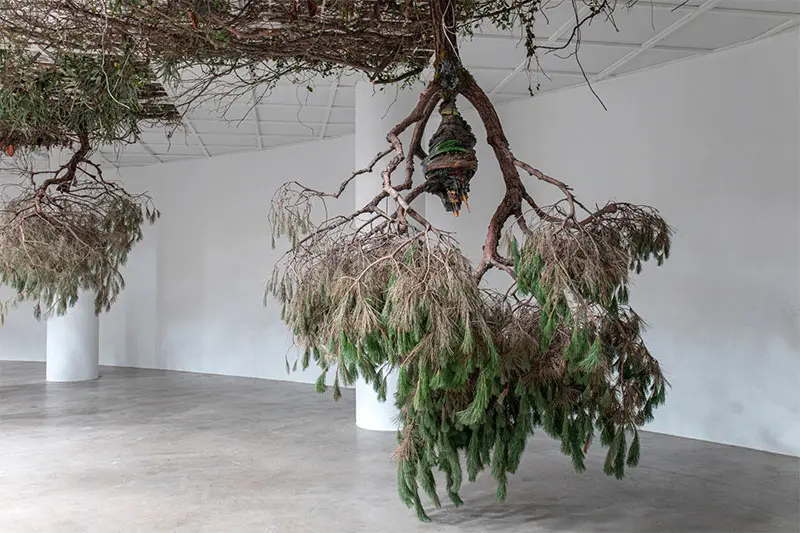
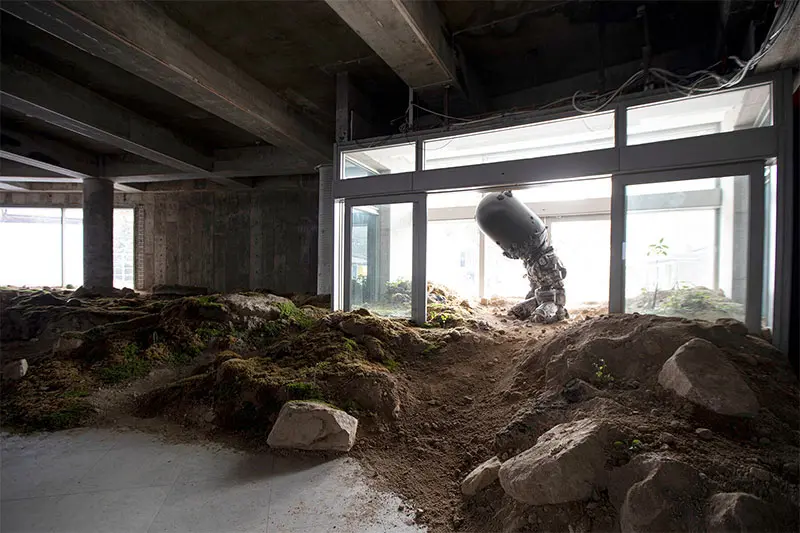
For the first time in the history of the Art Sonje Center, a site-specific installation encompasses all four floors, including corridors, stairwells, restrooms, the cinema, and other peripheral spaces. A mound of soil blocks the entrance, all temporary partitions are removed, and the walls and columns are stripped back to their core. Soil, fire, and plant life are introduced, blurring the lines between the interior and exterior and intertwining ecological and institutional realms. Exit signs transform into ambient lighting, while humidity and temperature controls are taken down, exposing the building to the whims of external thermodynamic forces.
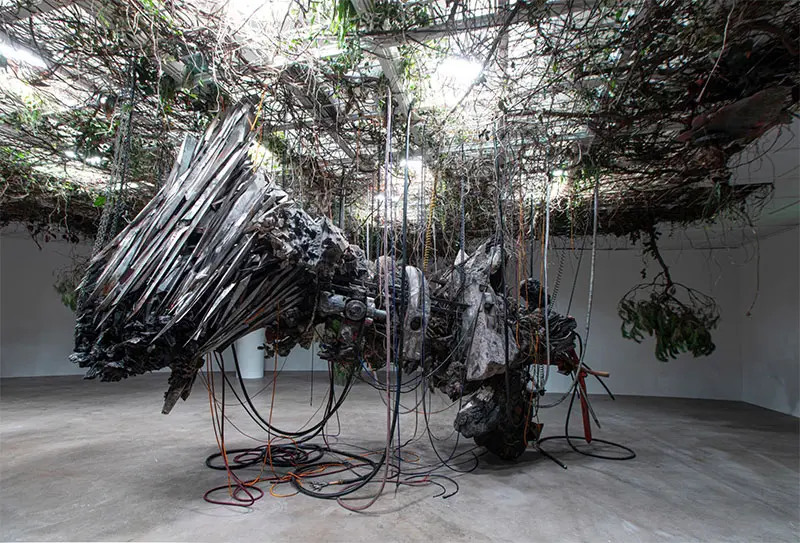
At the heart of the exhibition is a constellation of chimerical sculptures from Villar Rojas's ongoing series, The End of Imagination (2022–ongoing). These haunting, otherworldly forms seem to be excavated from an unknowable future. First revealed at the Art Gallery of New South Wales (2022), Helsinki Biennial (2023), and Foundation Beyeler (2024), the series emerges from the artist's innovative "Time Engine," a bespoke digital simulation tool that merges video game engines, artificial intelligence, and speculative world-building. This tool generates synthetic worlds filled with evolving life forms, unique architectures, distinct ecologies, and complex sociopolitical conditions.
Between 2021 and 2024, Villar Rojas and his team 'downloaded' these virtual sculptures and began the process of bringing them into the physical realm, meticulously preserving the traces of their digital journeys. Created in a temporary workshop in Rosario, Argentina, the sculptures are composed of layered organic and inorganic materials: metals, concrete, plastics, soil, glass, resin, salt, tree bark, auto parts, and more—each piece infused with both human and machine labor. Villar Rojas explains:
"These digital ecologies generate things—just as Earth produces birds, trees, rocks, and machines. This approach reverses the core ontology of the creative act. I often say, when talking about this family of works, that I model worlds, and the worlds model 'sculptures' for me."
Emerging at a moment when humanity teeters at the edge of its own continuity, Villar Rojas's work inhabits the liminal space between extinction and inheritance. Reflecting on the exhibition title, the artist says:
"When I speak of The Language of the Enemy, I'm pointing toward a deep prehistory of meaning-making. We, Homo sapiens, didn't invent symbolism in isolation; we evolved alongside other human relatives—Neanderthals, Denisovans—and in those encounters, hostile and intimate, competitive and collaborative, something passed between us. Tools, gestures, fire—but also the first sparks of symbolic thought, of meaning creation. The exhibition's title gestures to that paradox: the enemy—this manifestation of pure otherness—is alien and threatening, yet also the mirror through which we first recognized ourselves. Today, I think we are again at such a threshold—facing new "others," synthetic intelligences, whose languages we barely comprehend. These intelligences are here, coexisting with us; we pass knowledge to them, even as we sense that, in doing so, we may be preparing for our own disappearance."
This exhibition marks the culmination of Villar Rojas's long-standing engagement with Korea, including initiatives like the Real DMZ Project (2014–ongoing), the 5th Anyang Public Art Project (2016), and the Gwangju Biennale (2018, 2021). For the Art Sonje Center exhibition, a team of eleven long-time collaborators—many of whom have worked with Villar Rojas since 2009—traveled from Argentina to Seoul to fabricate the exhibition on site for six weeks. Acting as a hybrid of hive mind, theater troupe, and terraforming agency, the team transformed the Art Sonje Center into a handcrafted, living ecosystem. Adrián Villar Rojas: The Language of the Enemy also commemorates the inaugural exhibition held thirty years ago at the Center's location, a pivotal moment in establishing its legacy.
Gallery