ObituaryNovember 14, 2018
Adolfo Nigro
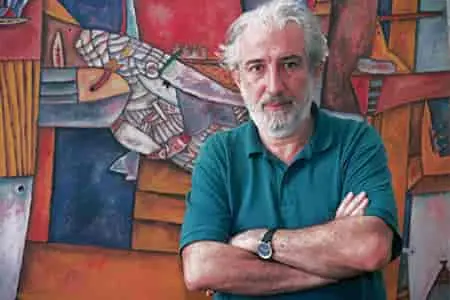
Argentinean artist Adolfo Nigro died recently in Buenos Aires at the age of 75. Associated with the so called School of the South—created in Montevideo in 1934 by Joaquín Torres-García on his return from Paris—Nigro was born in Rosario in 1942 and moved to Montevideo in 1966. There, he had a decisive encounter with Uruguayan painter José Gurvich, a student of Torres-García. Through this productive exchange, Nigro began to turn drawing into one of his most important expressive mediums. In 1967, Nigro began to incorporate collage in his oil paintings and drawings, which visually helped him to disrupt the rhythm of drawing and to underscore the autonomy of the work. His pieces with ceramic (1966-1972) fueled his interest in the Pre-Columbian world and inspired abstract-geometric designs of an Americanist style. It was an influence that forever marked his work. Nigro's world is the world of objects. He connects them to his experience, to his need to observe and touch his surroundings. Until the mid-1980s, his lines gracefully rendered them weightless, partially defined, as he often relied on a unifying profile that acted as the organizing element. He returned to Buenos Aires in 1947. There he developed the rest of his artistic production, beginning with the series "Horizons," "Inhabited Skies," "Migrations, "The Calendars," "Navigations," and, in drawing, "Natural Domains." All of these works convey his relationship with objects, the events that unfolded in his life, as well as the influences of his favorite authors; Cesare Pavese—towards whom Nigro felt very close because of childhood and adolescent experiences that exposed him to the land and the moon—and Italo Calvino, whose novel Il barone rampante (The Baron in the Threes) he illustrated and who gave him the idea of the flow between beings and things on earth and the sky. This is the reason why Nigro's gaze sometimes focuses on the roofs and the sky above as whirlwinds of heterogeneous objects ascend around a central axis towards the boundaries of outer space. The cities he depicts are always his cities: Rosario, Buenos Aires, and Montevideo. And the objects are always those he considers unique and irreplaceable: the moon, piles of things, the wheel, boats, and so on and so forth. His use of horizontal strips suggests transient states and allude to different memories or states of mind. The series that bests represents Nigro is "Migrations" (1981), which consists of oil and acrylic paintings where objects appear to be rushing as if being overwhelmed by a need to escape, by the loss of friends, by exodus. This preoccupation of his had already appeared in "The Letters" (1976), a series that alludes to his anxiety about messages from friends that left. These are the series that are most closely associated with his social and political preoccupations. Beginning in the mid-1980s, the objects in his work acquire a different tone that underscores their metaphorical value and renders them more contradictory and menacing. They now completely invade the base plane, redefining the notions like infinite and polyphony, and contribute to a higher lyric density. Time flew by when, in 1988, I had the opportunity to collaborate with him in the publication of his book. During that project, we engaged in wonderful conversations spoken in the languages of art and poetry. Then, as Cesare Pavese wrote: "For each of us, death has a gaze."