The second edition of the Art Cartagena Art Fair was held earlier this year in Cartagena de Indias. The event’s organizers commissioned Santiago Rueda Fajardo as curator of an exhibition titled Caribe Conceptual. This exhibition interested me because it materializes certain contemporary theories, already expressed by Gerardo Mosquera1 and even Nicolas Bourriaud2 in their most recent investigations on contemporary art: the issue of origins is not fundamental; Mosquera insists that we don’t need to ask artists (and, in consequence, their works) for their passports or identity cards, while Bourriaud, along very similar lines, tells us that origin is problematic because they enhance fundamentalism. And when we speak of origins, we are talking about those (postmodern) identitarian postures that have rendered these notions an insurmountable enclosure, a ghetto where nothing coming from outside is accepted and where artistic production is encased within fixed conceptual boundaries. However, this posture does not negate the experience of place, since the artist includes in the exhibition are, as Rueda puts it, “clearly marked by the Caribbean experience.”
With this exhibition, Santiago Rueda is able to emphasize a certain idea of the Caribbean, rather than the Caribbean proper. Thus, what is in question is the place in itself. Starting with its title, already a provocation, the idea of Caribe Conceptual points more toward the idea than the region. This is not at all the Conceptualism of the Caribbean. When I ask how he dealt with this curatorial idea, Rueda responds:
“Starting with the invitation to build an exhibition of artists “from the coast”, I came up with a broader concept, thinking about the Caribbean as a diverse, extended, and transnational geographic and cultural area. This, after inviting six Colombian artists from different generations, from Álvaro Barrios to William Aparicio, I selected a number of works that construe, in a testimonial, allegorical, and conceptual ways, the Caribbean and the experience of the profound cultural mixture in it, from the perspective, as I just said, of six contemporary Colombian artists.
Caribe Conceptual is a judicious curatorial proposal by one of Colombia’s most relevant curators and theorists today, and it brings together two well-established figures such as Álvaro Barrios and Ofelia Rodríguez, an artist with a solid career like María Isabel Rueda with Carlos Castro, Ana María Rueda and three emerging artists who despite their youth already possess important national renown: William Aparicio, Fernando García Vásquez, and Emma Anna. Five of them come from the Caribbean region and one of them from the interior of the country, which guarantees an openness beyond the purely regional.
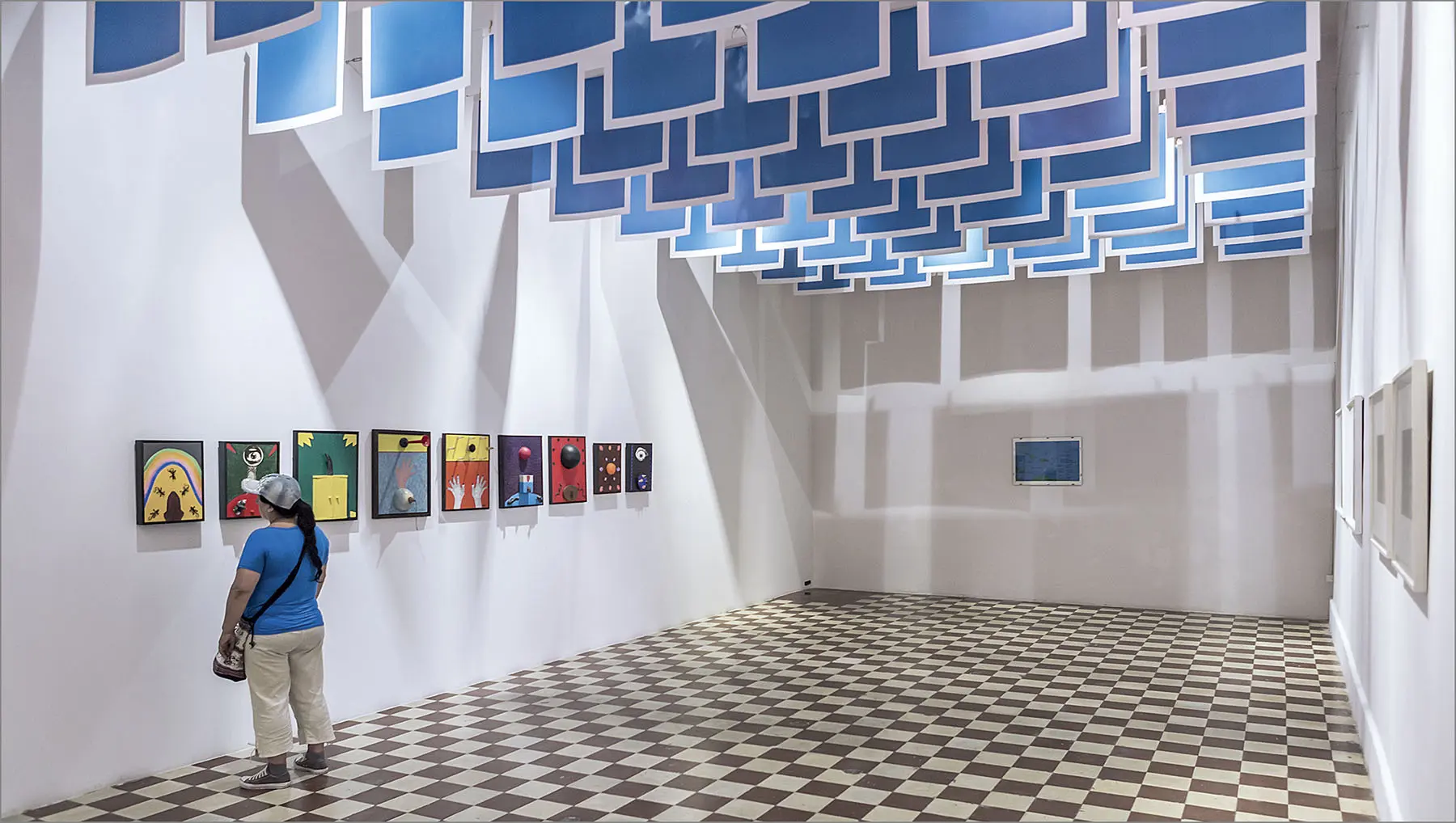
Álvaro Barrios presents two works. The first one, El mar de Blas de Lezo (The Sea of Blas de Leso,) 2015, other seas are already seen in his large retrospective at the BLAA, covers an entire wall with papers printed in blue on one side and red on the other. The papers flutter lightly above our heads, like waves. This work alludes to the Spanish warrior who defeated the British in the famous Battle of Cartagena. Barrios shows the contradictions of an era when the fort from where local riches sailed to Spain was defended at all cost. The blue color of the sea contrasts with the red of the blood spilled for centuries by those who held colonial power. Barrios’ second work, Diálogo de Reinas (2013) also revisits colonialist conflicts where the seas play an essential role: the Falklands War is the historical background for this work, based on the fictional correspondence between Evita Perón, Margaret Thatcher, and Queen Elizabeth II. The letters between the three reveal the conflict between Argentina and the United Kingdom as it intensely flared up in the 1980s.
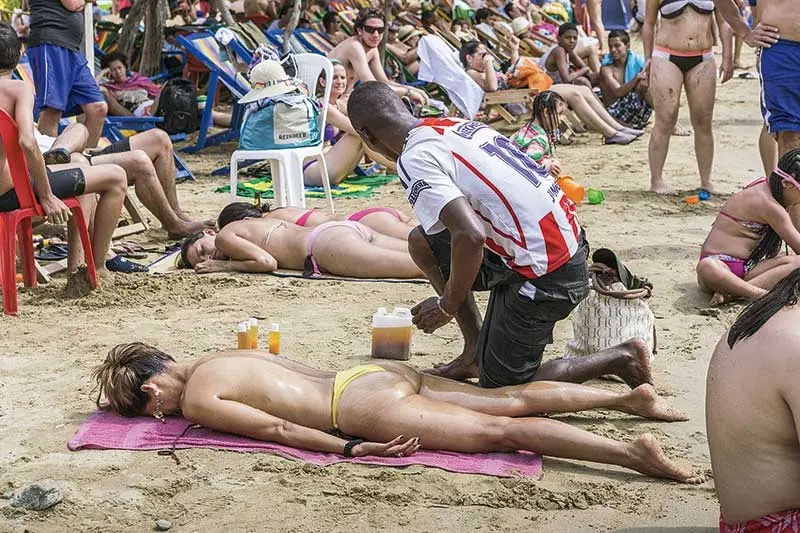
William Aparicio exhibits two large photographs with the title of La Playa (2014). In one of them, local informal workers, who make their living in this way, massage the bodies of female tourists with sea oils. The images reveal a mixture of eroticism and exoticism, questioning the idea of relaxation and the vision of sexual tourism. The other photograph presents us with a number of tourists sitting under palm trees: the situation and the colorful scene in that crowded vacation spot bring to mind those impressionist situations painted by Renoir in the late Nineteenth Century. There is plenty of humor and irony in these works, which show a different situation of tourism: during the “high season,” the vacation spot becomes a veritable parking lot with no space for tranquility.
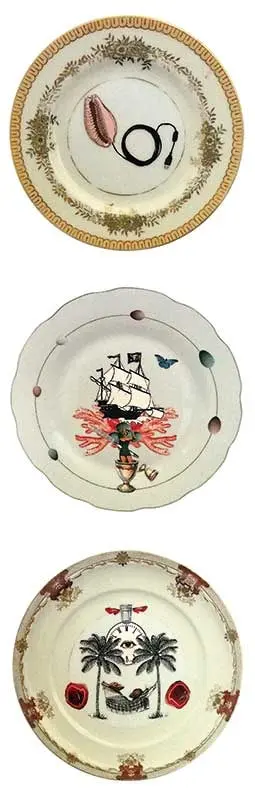
In her Made in China (2014), Emma Anna collects Chinese-made flatware and intervenes it in the way of collage. The pieces, especially plates, are arranged on the wall to become the support for a local imagination that hybridizes with mass manufacturing. The artisanal aspect of the local and the global invasion of the “Made in China” interrogates the reality of the market and the status of the popular as a consumption item. At the same time, these works materialize the idea of identity, since at first glance they look like flatware painted with Caribbean motifs. The installation of the pastiche questions, with irony, the idea of the regional. Here there are no longer regions, but an exchange of influences and materials.
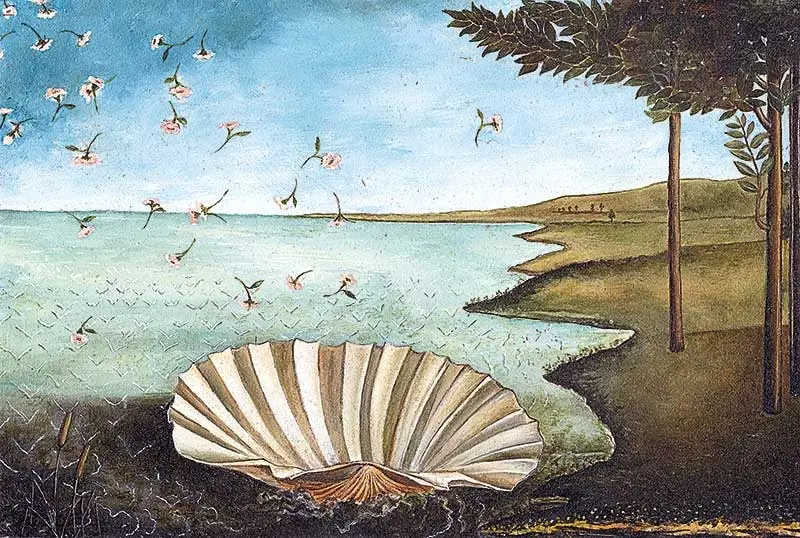
Fernando García Vásquez, with his Serie desnudos, El eslabón perdido (2008-2013), creates a series of small-format oil-on-wood paintings which appropriate art-historical images by such figures a Botticelli, Magritte, Brueghel, etc. These works generate tension as the characters have strangely vanished from the plane of representation; this transforms the works into veritable scenes of a crime. Desolation dominates these works: Botticelli’s Venus has vanished, Magritte’s characters are no longer present, and the multitudes painted by Brueghel have left the pictorial frame. Such an emptying-out brings to mind the tension between photography and painting where subjects make way to objects. Subjects no longer interest us, Francis Picabia said at the high point of Dada. García seems to insist on the point, but these works are imbued with a strange sensation uncanny, Freud would say with images that are strangely familiar to us. The characters seem to have fled somewhere else as if the worst were about to happen there. These works, in my judgment among the best in the exhibition, always provoke a smile.
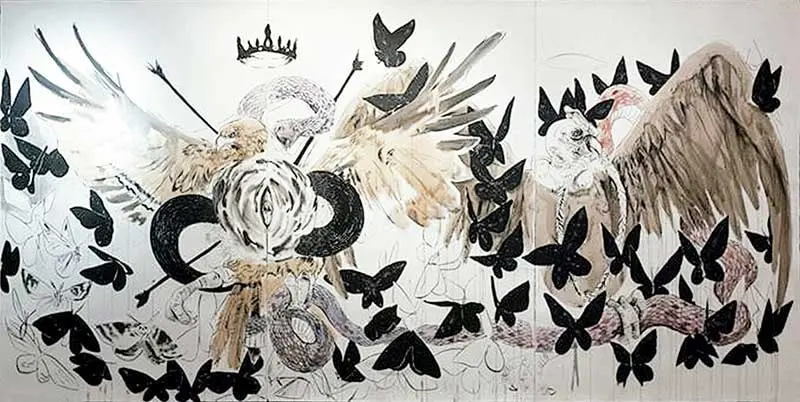
María Isabel Rueda presented a large-format work: Obra negra (2010), created in collaboration with Mexican artist Marcos Castro. In this work, we see the animals featured in the national seals of Mexico and Colombia (eagle and condor) in the struggle against a great serpent, while a number of black and white butterflies flutter around them. Black butterflies have always been taken for bad omens, which reinforces the dramatic idea of this combat between national sentiment and a serpent, an animal damned by the Christian vision but here recovered in its pre-Hispanic force. Each animal seems to be fighting within that imagination of the national sentiment of our two countries. However, the idea of otherness is emphasized by the current tragedy of Mexico, similar to what Colombia is struggling to leave behind.
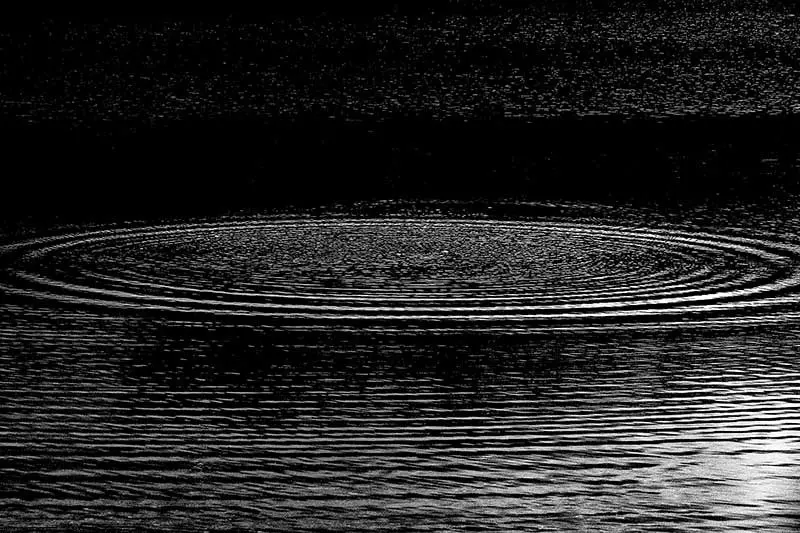
Ana María Rueda exhibits two black and white photographs alluding to the world of water: the clash of a droplet against a watery surface is the pretext for the creation of an image of great poetic force. These images from the series Yo soy también el otro create an ephemeral drawing that the artist fixes by means of photography. We find here a signal of otherness, no longer in terms of the individual (as Rimbaud would put it, “I is another”), but, rather, assuming the difference in natural terms; the effect of expanding in nature, in this case in the water, and itself becomes water. Existence itself is assumed in natural terms, and Being becomes pure nature.
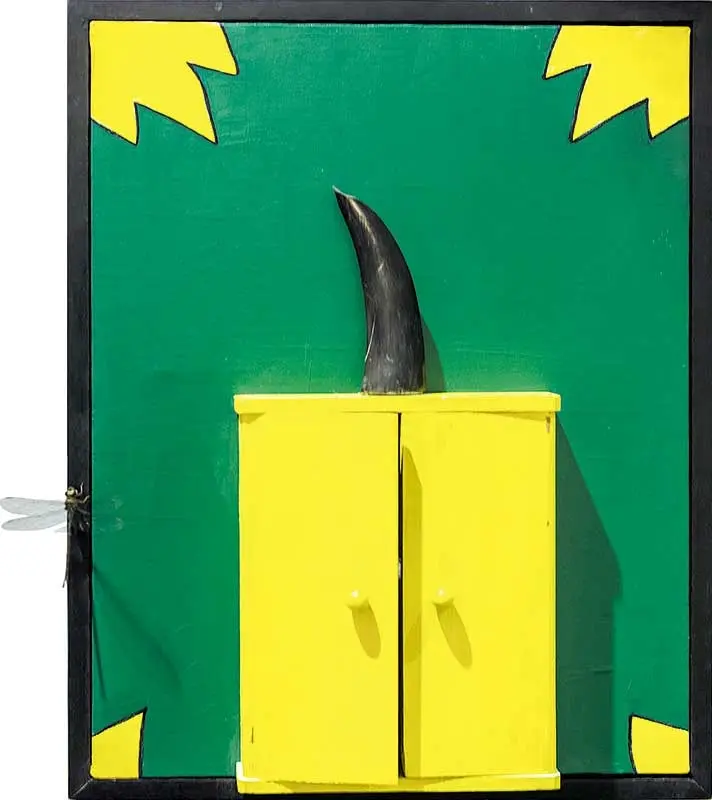
Finally, we were able to enjoy the work of Ofelia Rodríguez, a pioneer of Pop Art in Colombia. Her pictorial works forcefully remind us of a certain pop culture framed within the Caribbean tradition and the popular-religious element of the Boyacá region. There is an interesting syncretism in her work, where the influence of styles and traditions render her entirely objectual “painting” an art that allows us to experience the traditional and the contemporary. Something rather difficult when we are talking about artworks that question painting without setting it aside. An oeuvre that, for a good while now, is part of the history of Colombian art, recognized by Critics like Germán Rubiano, Álvaro Medina, Eduardo Márceles Daconte, and José Hernán Aguilar, among others.
Caribe Conceptual is a curatorial gambit that enriches the landscape of the Cartagena art fair, which, while clearly commercial in intent, takes with this kind of exhibition its place alongside great events such as ARCO and ARTBO, filled with an authentic pedagogical spirit interested in interrogating in artistic ways their very location. There were those who opposed this show, questioning its lack of research in the region. However, Santiago Rueda once again presented a serious work, demonstrating that the Caribbean is much more than beaches, breezes, and seas.
NOTES
1. Mosquera, Gerardo. Contra el arte latinoamericano. http://www.esteticas.unam.mx/edartedal/PDF/Oaxaca/complets/mosquera_oaxaca.pdf and in conversations with the author for an unpublished interview, Mosquera ratifies the concepts.
2. Bourriaud, Nicolas. Contra la posmodernidad. http://www.artishock.cl/2013/09/contra-la-postmodernidad-y-la-cuestion-del-origen-entrevista-a-nicolas-bourriaud/ An interview with the author.
RICARDO ARCOS PALMA