Water as an allegory has become a central subject in the work of the Río de Janeiro artist Ana Claudia Almeida. In paintings, drawings, and installations that propose this element as a metaphor of mutability, the ephemeral, and the relativity of existence, Almeida creates what he has called a “geography of emotions”. Exploring the depths of the relationship between subjectivity, nature, and landscape, Almeida creates abstract images whose expressive atmospheric effects derive from the dense materiality of their surfaces.
All this is in full display in Almeida’s recent exhibition at Fortes D’Aloia & Gabriel gallery, located in Aquario, Carpintaria, Río de Janeiro. Her investigation, directed towards an aesthetic elaboration of the physical world, shapes the theme of the works on exhibit: three Brazilian rivers and their stories. The rivers are the Guandu, which provides water for the Río de Janeiro metropolitan region; the Paraguaçu, which borders the cities of Cachoeira and São Félix in the Bay of All Saints region of the state of Bahia and was a key waterway during the colonial era; and the Piraquara, which cuts through the Realengo neighborhood in western Río. On the basis of a large number of symbolic associations, Almeida’s works showcase her imaginative repertoire and creative strategies, exploring spatialities other than painting, its central axis, and expanding in that way the boundaries of aesthetic experience.
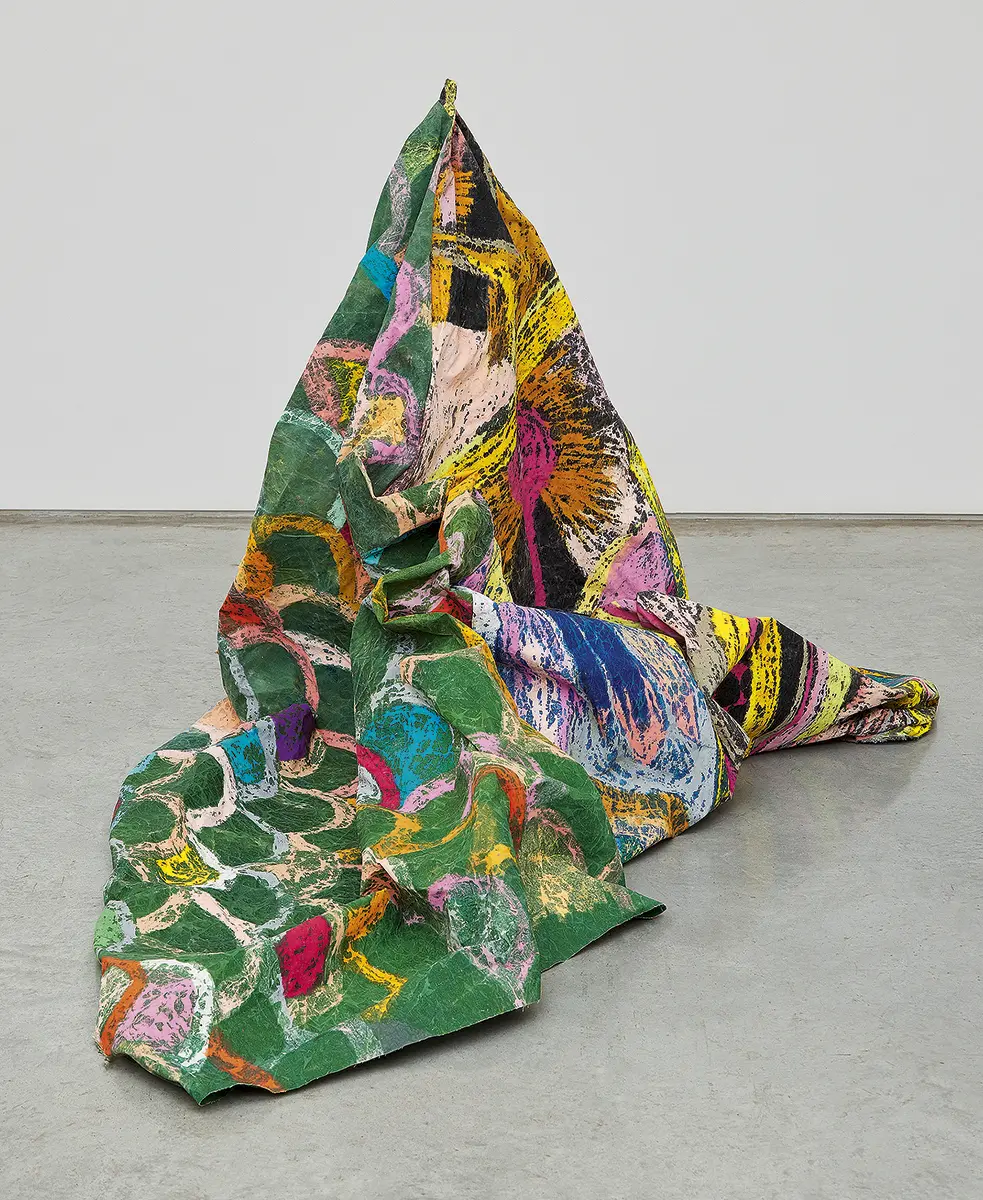
Almeida took the space of the gallery as the starting point for the creation of her works, shifting the pictorial surface in the direction of three-dimensional space. The exhibition is comprised of works that dialog with one another. Guandu (2023), a large oil painting of non-continuous color zones, rough textures, and vigorous brushstrokes, resembles the aerial view of a hydrological basin, with small islands, rapids, river mouths, and estuaries. Paraguaçu (2023), an installation comprised of a large canvas tarp painted in oil pastels and resin that hangs from the ceiling to rest on the floor, appears to be an extension of Guandu, as if the latter had become dislodged from the wall to flow into the gallery space. Piraquara (2023), a short super-8 film, juxtaposes images of the titular river to interviews with people from the region; one highlight is Almeida’s own grandmother’s testimony about the experience of migrating from Bahia to Río de Janeiro.
Almeida has worked with aquatic landscapes from the start of her career. Her images, which traverse the vertical, horizontal, and diagonal axes, result in restless lines; these are images in motion, here as much as in earlier works. In her 2020 video installation Interesses da Continuidade (Interests of Continuity), for example, Almeida superimposed video images on an abstract painting. The video featured the water jet from a drain pipe discharging its uninterrupted flow onto a river. The texture of the painting’s static image seemed to fuse with the video images, setting up an interesting ambiguity. Viewers encountered the same language in Almeida’s first solo show in São Paulo, in 2022, at the Central gallery. Titled Buracos, Crateras e Abraços (Holes, Craters and Hugs), it featured canvases and fabric installations that evoked the idea of painting as an expanded field, highlighting the intrinsic relationship between the fabric pieces arranged around the gallery and the two-dimensional canvases, which, based on abstract compositions of organic forms that intermingled form motions resembling aquatic and atmospheric rhythms, seemed to represent aerial views.
In 2021, Almeida took part, with Carla Santana, in the project “Submersiva – Ato I” (Submersible – Act 1), which consisted in the creation of a painting on the bottom of a swimming pool in the Auroras space, in São Paulo. Set at the boundary between painting, installation, and performance, the process was open: visitors to the space during the month of November of that year witnessed a choreography of the painting, represented by the two artists. In the project’s climactic moment, the pool was filled with water, which contributed refractions and optical distortion effects, adding to the motion of the water the painting’s organic shapes, as well as the reflection of the sky above and of surrounding elements, and turning the work almost into a living entity.
Ana Almeida uses painting and drawing as starting points. Graduated in Industrial Design from UERJ and Virginia Commonwealth University in Richmond, Virginia (USA), she discovered art as a life option through her participation in the Trovoa collective, to which she belongs since 2017, and in the commonality of interests with other members. Almeida has taken part in exhibitions at Galpão Bela Maré, Parque Lage, Museu de Arte Moderna do Rio, Museu de Arte do Rio, Paço Imperial, Museu da República, Instituto Tomie Ohtake, and other spaces. She also participates in residencies at Valongo Festival, Pivô Pesquisa, and Rato Branko, and was nominated for the PIPA and EDP das Artes awards.
A look at Ana Almeida’s career reveals that she has remained faithful to her “geography of emotions,” shaping her poetics with coherence and steadfastness. The surfaces of her paintings and drawings, filled with rich possibilities, are always circumscribed between the idea of acting on an extended time, connecting it with the solidity of plastic materiality, and the fluidity of meaning in art and in life. Hers are abstract passages that evoke nature’s, and human beings’, constant transformations.
ALESSANDRA SIMÕES