Since the end of the last century, art no longer operates as a window to the world or as a reflection of some emancipating perspective, but as a strategy. In the contemporary world, every work of art—whether a single object or the exhibition of a unitary whole—points to a historical awareness, to a battlefield where artworks and receptors are invited to a game (of language) whose current rules, and the way they ought to be implemented, must be reviewed in advance. Before this prerogative, and in the many receptors of the most recent exhibition proposal by Andrey Zignnatto, one must ask: What mechanisms are activated in this exhibition? How to be a good contributor?
Zignnatto made his debut a decade ago, in the context of an art scene in São Paulo ruled by jury and award circuits. Since the beginning of his artistic career, his work has appeared as an activator of the labor universe: ordinary or exotic mudbricks, concrete or mortar joints, walls, and construction fragments have been used by this artist in multiple gestures, cut or mended. These raw materials extracted from everyday life—walls, bricks, photos of certain ruins or areas immersed in social conflict, in places like Peru or Dubai—often embody actions that serve as elemental and urgent poetic messages. Viewers will not require much information to understand this leitmotiv. The raw material is already iconic in its own right, a vignette that brings reality and fiction closer, the self and the other, so the sculpture, architectural project, or photographic record can be shared and received with their full expressive power. In this manner, the image becomes a reliable source (it can be trusted), making us accomplices of its statements, its etymological reasons and, in sum, of the entire artistic process contained inside and outside of it.
In the series that inspired the title of the exhibition, “Construction Site (Affordable Housing)” (2017-2109), Zignnatto “reconstructs” parts or fractions of the typologies of low-income homes created through the program Minha Casa Minha Vida (My Home, My Life). The entire series will be completed in six or seven phases, each featured in a different exhibition until an entire house is built. The first stage was completed in a solo show at SESI (Tauí, São Paulo), after the Zignnatto received an award granted by that institution. And the second stage is presented now at the Janaína Torres Galeria. After the walls have been erected, they are partially destroyed to expose some of the framework and mortar residues to achieve the visual effect of a precarious formwork. While the original project has been respected—by preserving its precise spatial distribution and other proportions—the artist underscores a sense of fragmentation and doubt by confronting us with the fragile nature of the piece.
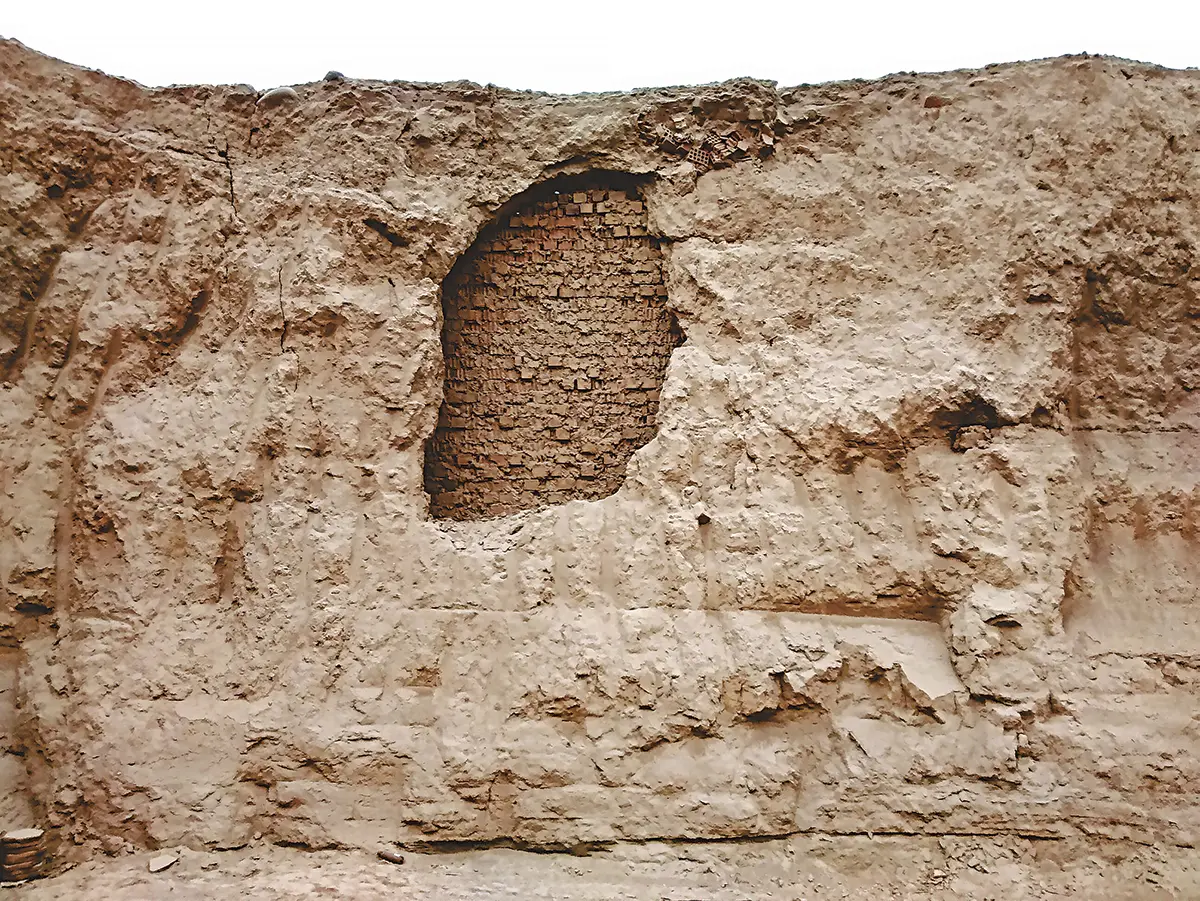
This precarious architecture and its deterioration serve as the context for the photographic series titled “Crack (Huachipa)” (2018). Created in Huachipa, Peru, the series is a sort of archeological site like the many ruins of Inca culture that still remain in the region. There, Zignnatto gathered enough bricks to “mend” the walls. Such was their state of neglect that it was not only possible to put them back together but also to relocate them to their “original place.”
Examples like the one in Peru are repeated in the United Arab Emirates. Clearly, one of the most important approaches in Zignnatto’s work is the evocation of several cultures. Not content with reflections exclusively about the universe of his country, unlike most of his contemporaries he has traveled to places that are conspicuously marginalized, either because of a history of colonization or as result of sociopolitical circumstances. These travels are a consequence of a parallel activity of his: participating in prestigious international humanitarian aid projects as a volunteer teacher in communities affected by extreme poverty or located in war zones.
With this objective in mind, he recently traveled to Qatar, Sharjah, Dubai, and South Arabia. Based on this trip, he produced the series “Prayer Mats” (2018), under exhibition, and “Black Mass” (2018), which he presented a year before at the Sharjah Art Museum. Both series are a form of protest against the slavery-like conditions of construction workers in those countries, where, incidentally, architectural luxury is one of the major selling points of tourism. This series alludes, as its name indicates, to prayer. It is a tradition performed by everybody, from the poorest person to those at the top of the economic ladder. The piece reappropriates discarded cement paper bags and places design patterns on them cut in advance from original rugs. The result is a combination of opposites and the highly risky action of damaging religious objects. Darkness is present throughout the series “Black Mass,” consisting of curtains made out of strips—created with an asphalt-based material—arranged in a cubicle. Upon entering, viewers are confronted with the total absence of light. The curtains become a residual sign as well as a warning.
Manifestations like those by Zignnatto cannot just be regarded as mere aesthetic experiences or interpreted, as many contemporary proposals are as polished, finite, or self-absorbed essences. Like a snake, art has left its old skin behind and today more than ever this sort of ambiguous nature propitiates a dynamic with marked aesthetic connotations. It brings with it the cracks and fragility present in every utopian project. Once the levels of skepticism that prevail today have been readjusted, the artist returns as a proponent of micro-utopias and actions that are viable for him, responding to extreme negativity with a fertile new beginning.
XENIA BERGMAN