Dec 2015 - Feb 2016
artnexus #99
Arte in Colombia #145
Carlos Amorales (1970) is today one of Mexico’s most internationally renowned artists, with a body of work in which drawing, animation, music, sculpture, performance, film, and, more recently, painting combine to display a multifaceted attitude towards aesthetic exploration.
The constant process of construction of his database—his Liquid archive, as he dubs it—reveals Amorales’ ability to expand the boundaries of draftsmanship and graphic language in his digital images, an ability that makes it possible for him to crossbreed different techniques and engage political and social subjects in a universe where reality and fiction are interwoven.
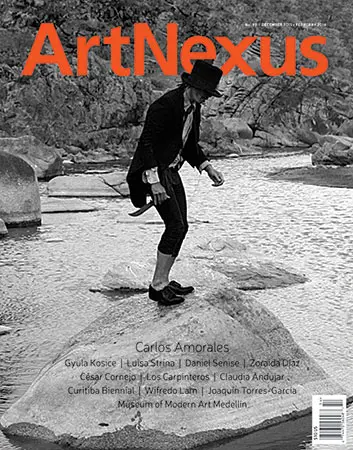
And it is just such drive to appropriate a variety of resources in the creation of his images that buttresses Amorales’ interest in the film. The image on our cover comes from his 40-minute black-and-white film El hombre que hizo todas las cosas prohibidas (The Man who did all Things Forbidden, 2014). The work, commissioned by the 8th Berlin Biennial, explores languages from the fields of music, visual arts, and texts.
Two central investigations course through El hombre que hizo todas las cosas prohibidas: on the one hand, the poetry that emerged in Chile after Augusto Pinochet’s 1973 coup; on the other, the imposition of that country of a neo-liberal economic model.
The script, created by Amorales, is based on fragments of Chilean poetry from the period, reflecting different—and even opposing—political positions. There is minimal dialog in El hombre que hizo todas las cosas prohibidas, and the interpretive and musical resources it deploys bring to mind those of silent film.
Once again Amorales makes use of literature, here by way of a piece by Chilean writer Roberto Bolaño, whom he had already referenced in Vagabundo en Francia y Bélgica (Vagabond in France and Belgium, 2011), which shares its title with one of Bolaño’s short stories. The central character in the film is Carlos Wieder, also the protagonist of Bolaño’s novel Estrella distante (Distant Star).
Amorales builds an aesthetic sequence on the basis of a term he has invented: ideological Cubism, defined as “strictly a mental construct. It establishes that the future of art cannot be manufactured, that it must be a product of the mind, made of words.”
IVONNE PINI
* Código. Arte- Arquitectura- Diseño Magazine. Mexico, September 24, 2014.
IVONNE PINI
* Código. Arte- Arquitectura- Diseño Magazine. Mexico, September 24, 2014.
Issue Number: 99
Arte in Colombia: #145
Period: Dec 2015 - Feb 2016
You have 4 free articles remaining. Sign up for unlimited access.