Dec 2013 - Feb 2014
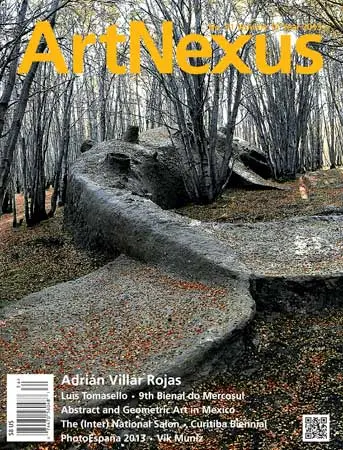
artnexus #91
Arte in Colombia #137
Adrián Villar Rojas (1980, Rosario, Santa Fe, Argentina) is characterized by works of oversized
dimensions, as monumental as the issues they engage. The origin of the universe, loaded with
primeval creatures who speak to us of apocalypse, transmutations, death, spaces of a world
that harks back to a thoroughly distant past that is nevertheless inhabited by machines and
complex devices seemingly allusive to future civilizations, expressed as the ruins of a world yet
to come. The theory of parallel universes where alternative worlds coexist with ours generates
complex visual speculations traversed by heterogeneity of cultural referents. Science fiction
and natural world intertwine to engender anachronistic visions in the construction of those
parallel worlds.
The materials with which the artist works, such as brick, clay, and clay dust, are for him not only
elements that contain time but possess a ductility that makes it possible to create the most
diverse shapes. Villar Rojas’ site-specific installations reinforce his interest in the way in which
the remains of man-made culture will be reprocessed, and with those materials, he builds figures
and forms at the scale we usually associate with monuments. And, as the artist said in
reference to his work for the 2011 Venice Biennial, “I build monuments because I am not ready
to lose anything.” But his is a fleeting monumentality. The material he uses to create it results,
as with many of the animals and architectures represented there, in their disappearance.
At 33, Villar Rojas’ many exhibitions—presented in such emblematic sites as MoMA PS1, the
Serpentine Sacker Gallery and Documenta 13—propose a way of seeing that questions our
everyday perception of the world and his monumental universes project other meanings of the
notion of temporality.
IVONNE PINI
IVONNE PINI
Issue Number: 91
Arte in Colombia: #137
Period: Dec 2013 - Feb 2014
You have 4 free articles remaining. Sign up for unlimited access.