Jun 2013 - Aug 2013
artnexus #89
Arte in Colombia #135
For some contemporary artists, working with archives is a key source of raw materials. Their exploration of archives follows
different criteria from those of art historians who also use documentary legacies, but they do share the same interest in
rendering their analysis problematic. Voluspa Jarpa (Rancagua, Chile, 1971) began working with declassified archives in the
1990s, making documentary studies that allow her to rethink Chilean history, explore its traumas, and propose alternative gazes
to the hidden stories. That process resulted in works like Biblioteca de la No-historia, which expanded her explorations to the
Southern Cone region and its geopolitical particulars.
Two situations, which the artist sets in parallel, operate in her reading of memory: on the one hand, a particular historical
discourse; on the other, the way in which subjectivity is expressed. To quote Jarpa, the two narrative systems in operation are
“the historical narrative as a convention of public discourse about collective traumatic events, and the discourse that funds the
subjective through the ‘disease’ that is at the point of origin of psychoanalysis: hysteria. On that basis, my investigation focuses
on generating an interweaving of hysteria and history, their languages, mechanisms, and images that make it possible for me to
render them visible”. *
In her installations, large paintings, and sculptural objects, those archives appear as scratched, intervened images, with
particular visual characteristics. The fragmented texts and the erasures leave abstract black lines that, rather than fostering
knowledge, question the notion of the archive as a source of knowledge. Jarpa incorporates into her works a variety of
techniques, for example silk-screening or photograph, revealing that along with the rigorous theoretical investigation she puts
forward there is a thoughtful analysis of the concept of representation.
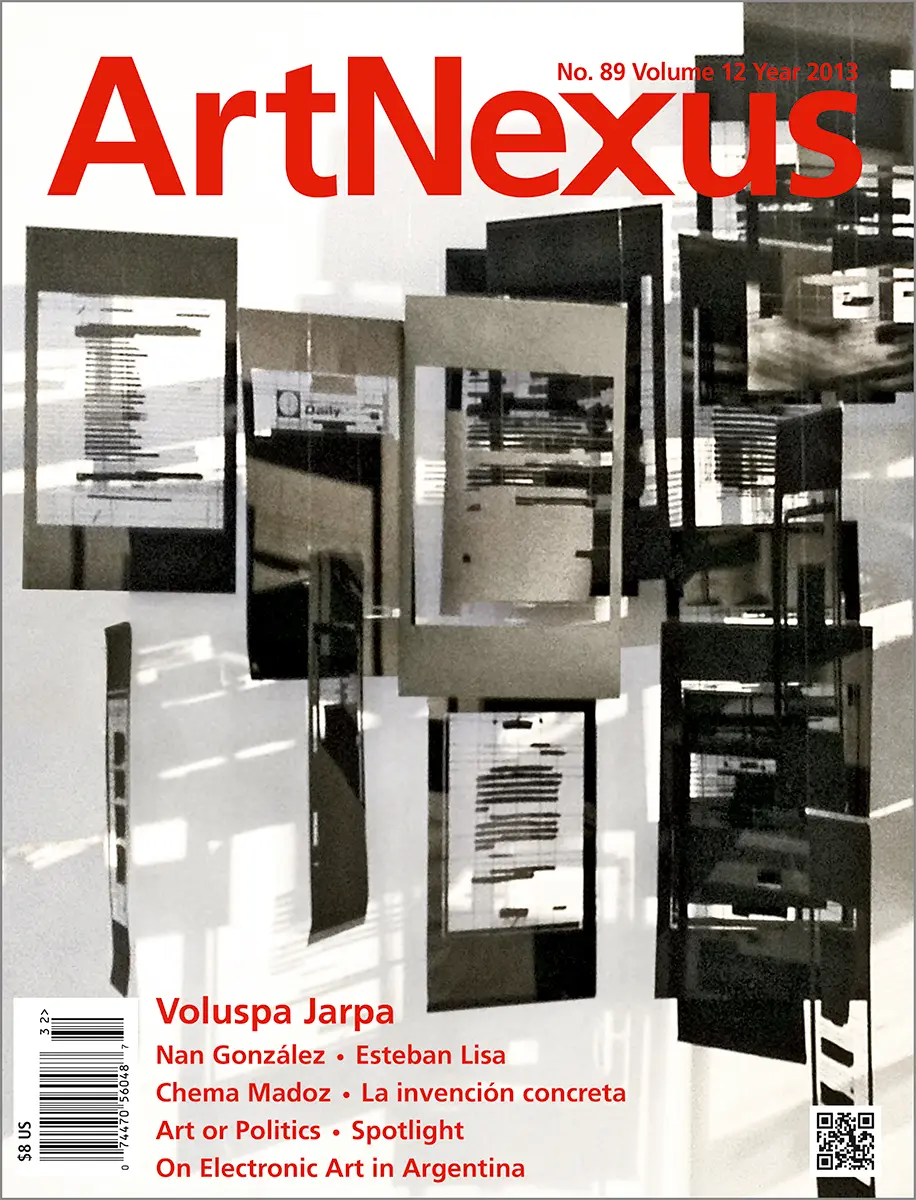
The work on our cover, Minimal Secret, uses 42 tar coated cardboard sheets to reproduce several documents declassified by the
CIA between 1998 and 2000, about events in Chile. The intention is to have us think about the need for a new historical reading
of these events.
IVONNE PINI
*arte-sur, 2013.
IVONNE PINI
*arte-sur, 2013.
Issue Number: 89
Arte in Colombia: #135
Period: Jun 2013 - Aug 2013
You have 4 free articles remaining. Sign up for unlimited access.