Dec 2012 - Feb 2013
artnexus #87
Arte in Colombia #133
One of the most outstanding characteristics of Gabriel de la Mora’s (Colima, Mexico, 1968) work is his inquisitive attitude towards different materials, interested in working with and on the most diverse of resources. Organic elements such as blood, hair, bones, photography collections, paintings and actions registered on video are all integral parts of his artistic inquiry. Parallel to his exploration, de la Mora’s work constantly refers to concepts related to time and memory, his own genealogy being a central point of reflection, and thus his interest for portraits and drawings in which he reveals his affective surroundings.
In the exhibition of his project Exposición Panamericana –which took place in Bogotá, at NC-arte-, de la Mora rather focused on a collective memory, reconstructing a particular historical event between Colombia and Mexico. In 1948, Fernando Gamboa –the head director of the Museo Nacional de Artes Plásticas de México- brought an exhibition of works by renowned artists such as Rivera, Orozco, Siqueiros and Tamayo, among others, to Bogotá, all under the frame of the IX Conferencia Internacional Americana (IX American International Conference). Coinciding with the preparation of the exhibition, the Bogotazo burst, this being the beginning of an era of general violence due to the murder of the well-acclaimed political leader Jorge Eliecer Gaitán. Gamboa, with the help of some of Bogota’s intellectuals of the time, safeguarded the works that were still crated, returning with them to Mexico and managing to keep such a significant patrimony out of harm.
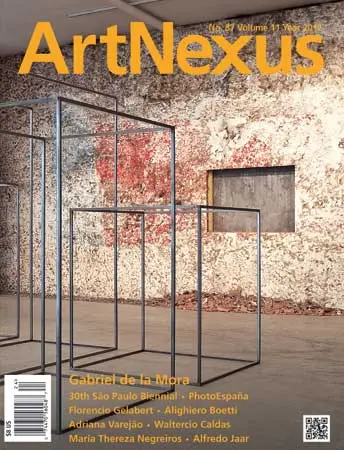
The intervention carried out by de la Mora in the gallery space contains clear historiographical referents, combining time-period documents, photographs, sounds, and scrapings of walls, all aiming towards the revelation of lost memories, and in reference to the failed Exposición Panamericana, the geometric forms that are incorporated in the space have the same measures than the original crates.
His investigation stimulates the viewer’s imagination and incites the discovery of a historic event, and thus making it contemporary. The “exhibition that never was” allows for de la Mora to explore Colombo-Mexican relationships on a different level, rather than that of drug trafficking–which is what is commonly alluded to when talking about the two countries.
IVONNE PINI
IVONNE PINI
Issue Number: 87
Arte in Colombia: #133
Period: Dec 2012 - Feb 2013
You have 4 free articles remaining. Sign up for unlimited access.