Dec 2010 - Feb 2011
artnexus #79
Arte in Colombia #125
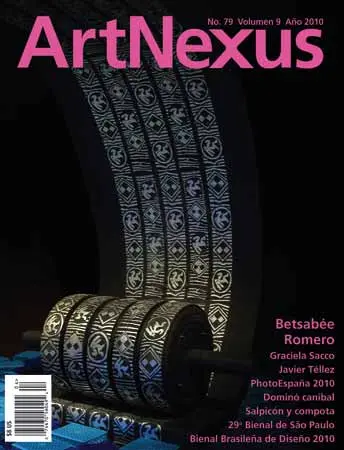
With an education that provides firm conceptual foundations —Master’s in Visual Arts, Art History at the Louvre, doctoral studies in Art History at the UNAM— Betsabée Romero (1963) explores the images and techniques of popular art and traditional handcrafts and uses them as her springboard for penetrating commentaries on various aspects of Western culture. An abandoned automobile became the central axis of her work, as she turned it into a kind of fetish object on which she creates unique interventions that open up a space for the unfolding of memory.
There is here an interest in not forgetting, in countering the oblivion that progress induces with its speed and constant flux. Her retrieval of traces allows Romero to connect post-colonial, baroque, popular-art, and artisanal references in dialog with the automobile, every day, mass-consumption object that can nevertheless be approached from a singular, more intimate perspective by each one of its users.
The world of the automobile and its parts becomes the visual vocabulary that makes it possible for Romero to explore suggestive fusions between contemporary artistic language and references from the past. This relationship between past and present results in the construction of certain emblematic images, using intervened pneumatics that display, for example, pre-colonial iconographies. As Romero states: “After engraving the tires in an archeological search for what is steamrolled under modernity, there came the idea of encrusting the trace. The black rubber drove me towards other scrap materials and I thought of chewing gum, a symbol of the culture that asphyxiates and drowns our memory because history has a living skin and the gum is just a passing flavor that is consumed and tossed.”
Using a variety of media —installations, photographs, sculptures, models in scale— Romero is able to have car and tire operate as basic structures in order to bring to the fore her concerns with history and the recovery of memory.
IVONNE PINI
IVONNE PINI
Issue Number: 79
Arte in Colombia: #125
Period: Dec 2010 - Feb 2011
You have 4 free articles remaining. Sign up for unlimited access.