Sep 2010 - Nov 2010
artnexus #78
Arte in Colombia #124
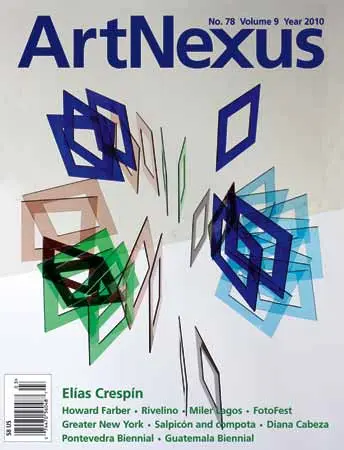
With his projects, Elías Crespín (Caracas, 1965) proposes a dialog between mathematical knowledge and representation. His undulations, his lines that intercross to form different geometric shapes, have the power to mesmerize the viewer, who completes the construction of the work in front of his or her eyes by looking at it.
Crespín’s education as an engineer provided him with essential tools, making it possible to combine technical knowledge and visual artistry. In a number of interviews, Crespín has identified the two elements that sparked his thinking as his proposal developed. On the one hand, his “turn to art” happened as he was looking at a work by Jesús Rafael Soto, a virtual cube, and was able to imagine the three-dimensional space in movement. He associated it with 3-D graphics programs and thought that the work could be modulated and changed with the use of such software. And on the basis of that interest, he understood that “if a printer is commanded to move its parts by a computer, then it should be possible to create a program able to move anything at will. I tried with many different motors and was able to have them move at the same time.”*
After several years of effort, Crespín was able to impress movement to his geometric shapes and have them dance freely in space, constructing a unique choreography that never fails to amaze its observers. His motto seems to be “paint the air,” as his works are redrawn every time they are perceived. They are created and recreated in front of the viewer’s enthralled eyes.
IVONNE PINI
*Dubreaska Falcón, El Universal, Caracas, November 23rd, 2009.
IVONNE PINI
*Dubreaska Falcón, El Universal, Caracas, November 23rd, 2009.
Issue Number: 78
Arte in Colombia: #124
Period: Sep 2010 - Nov 2010
You have 4 free articles remaining. Sign up for unlimited access.