Sep 2009 - Nov 2009
artnexus #74
Arte in Colombia #120
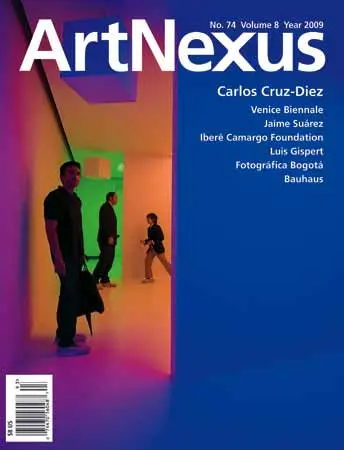
Research on color by Carlos Cruz-Diez (Caracas, 1923) began in late 1950. His concern about perceptual phenomena initially led him to his series Fisicromías, structures made with thin layers of color against which the movement of the spectator activates a particular color experience. The modulations of color are produced by displacement of the viewer and the environmental conditions of light.
His central point of reflection focused on the fact that color is not only an element contained in the painting but one which can be modified according to the relationships established between the colors and their effect upon the viewer, producing a certain juxtaposition of color. Hence, his “Trampas de luz” (“light traps”) as he calls them, manage to create color variations by those who perceive them, giving to the spectator a role as performer and active participant.
From his Fisicromías (1959) to his Cromosaturaciones (1968), Cruz-Diez raises concern about not accepting color as something definitive but something dependent on the perceptual environment in which it is placed; an environment that does not elude the public space, which may also be activated. Why this preoccupation about the study of color and its perceptual effects? His reflections lead us to the answer: “Color is a dynamic world, unstable, in this way similar to man who is a being in a continuous process of transformation. But if research on mutant colors has some human interest, it is thanks to what she can bring to the pictorial domain specifically, in the wake of the sensitivity and the apprehension of the world and the phenomena of perception in general.”*
IVONNE PINI
IVONNE PINI
Issue Number: 74
Arte in Colombia: #120
Period: Sep 2009 - Nov 2009
You have 4 free articles remaining. Sign up for unlimited access.