Mar 2009 - May 2009
artnexus #72
Arte in Colombia #118
Rosângela Rennó (Belo Horizonte, 1962; lives and works in Rio de Janeiro) builds her oeuvre on the basis of an exploration of pre-existing images. Archival, anonymous photographs, photographs from family albums, are gathered, analyzed, and intervened, with a focus on the cultural uses of the image and the limits both of perception and communication that the image may have. But also emphasizing their role as containers of memory.
Her photographs make visible elements of collective memory by exploring and salvaging situations that may come from the past, but acquire new perspectives of analysis when brought to the present. Rennó’s appropriation of old photographic images does not refer to the past as a simple temporal event, but appeals to its cultural implications, to the point that the past ends up becoming the present.
Works like those on the Military series (2000-2003,) which reproduce old photographs of men and children wearing military outfits, are worked in such a way that, as the artists say, they seek “an almost zero degree of visibility, in order to generate a sensation of the suffocation of the image.” It falls on the viewer, ultimately, to give meaning to the shadows.
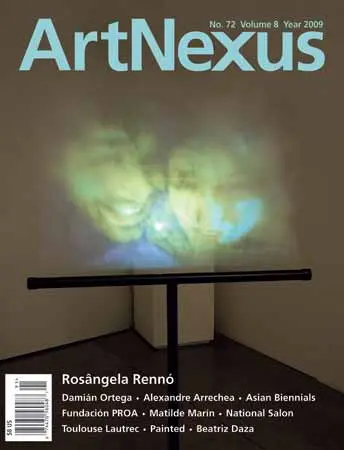
A similar intention is put forward in a work like the one on our cover, Experiencing Cinema, where a smoke curtain volatilizes the image. By replacing photography’s usual support, paper, with a smoke curtain, Rennó not only demonstrates her versatility in the use of a variety of resources but confronts her viewers with their own ghosts. It is as if the immaterial texture that the figures acquire reinforced the common notion that spirits dissolve in the air.
IVONNE PINI
IVONNE PINI
Issue Number: 72
Arte in Colombia: #118
Period: Mar 2009 - May 2009
You have 4 free articles remaining. Sign up for unlimited access.