Dec 2008 - Feb 2009
artnexus #71
Arte in Colombia #117
Rafael Lozano Hemmer (Mexico, 1967) studied Physics and Chemistry in Canada. This relationship with the sciences drives his activity as an electronic artist, with works that have seen him using new technologies to intervene in public spaces. Deploying resources as diverse as projections, sound, web connections, photography, tailor-made interfaces, robotics, cellular phones, and sensors, his works problematize the notion of virtuality.
Technology is for him more than just a tool; it is also the possibility, as an artist, of building new languages. In an interview with José Luis Barrios in Mexico City, Lozano Hemmer tells us that “I work with technology not because it is something original or new, but precisely because it is something inevitable and generalized in our global society.” Also, in his view, experiences in the visual field have traditionally been supported by scientific developments.
There is in Lozano Hemmer’s work a strong connection to architecture, which operates as a key element in the transformation of public space. The concepts of absence and presence are reiterated in several of his installations, and public space is reformulated not as a place of transit, advertising, consumerism, but as a site for its inhabitants to discover visual fantasies to which they can relate a time. This is why his proposals, despite having public spaces as their stage, differ from any reference to the monument: his works are, as he calls them, anti-monuments.
The use of technology also implies the possibility that his artistic proposal will reach a greater number of people. It is them who activate the interfaces the artist operates with, and it is them who allow the development of the interaction.
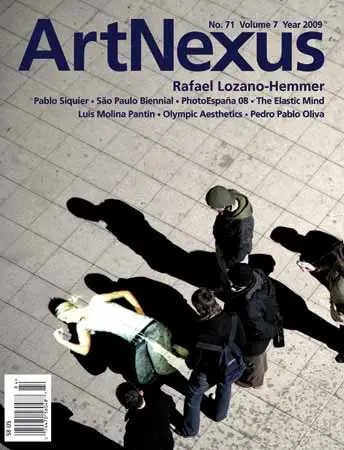
Under Scan, the work on the cover is an installation that the artist presented, on this occasion, at Trafalgar Square, London (November 2008). A variety of projected video portraits shows registers that cannot be seen initially due to the intensity of the light from a spotlight, but as people move, they reencounter with them. The work is conceived as an appropriation on the part of those who pass by the public space, once again relating high-tech with the possibility of self-representation.
IVONNE PINI
IVONNE PINI
Issue Number: 71
Arte in Colombia: #117
Period: Dec 2008 - Feb 2009
You have 4 free articles remaining. Sign up for unlimited access.