Sep 2008 - Dec 2008
artnexus #70
Arte in Colombia #116
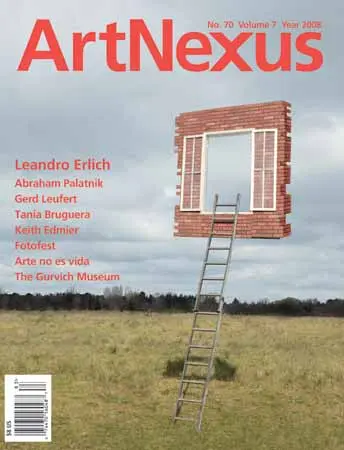
From his earliest works, Leandro Erlich (born 1973, Buenos Aires) has experimented with the possibilities of created situations that question our usual concept of reality. This is why his sculptures and installations play with the spaces we inhabit or frequent. This world of constructed illusion is based on the fact that, in the simulation, the viewer is the central figure, since the puzzles that Erlich builds with his spaces—of doors that cannot be opened, of mirrors that do not reflect—submerge the public in the bewilderment that such a situation generates.
But it is not only a matter of playing with notions of reality and illusion. Erlich’s works promote diverse and complex readings. There are no single realities; it is possible to imagine and build situations that invite our senses to participate and challenge basic criteria of perception. Our relationship with everyday objects is almost automatic, as if our familiarity with them makes it impossible for us to reflect on their meaning. Erlich emphasizes the importance of such objects and invites us to make the day-to-day into a reflective experience. He does not propose incomprehensible rushes to break the usual perception of things; on the contrary, his tricks are there to be discovered. The viewer becomes the actor, responsible for unveiling them.
These intentions help us to understand the comparison made by the artist between his work and that of a magician. Yet there exists between them a substantial difference: while the magician is careful not to reveal his tricks, sustaining the mystery of the trade, Erlich gives us clues. For him, discovery of the artifice is an essential part of the game, as is making his viewers aware of the symbolic charge that a space can possess or the suggestions contained in his materials.
As Elena Oliveras rightly observes, “We could say that Erlich’s ‘vision machines’ are also ‘meaning machines’ that function to revitalize our everyday experience, to bring us out of our generalized slumber and take us beyond the logic of the commonplace, to see the world with new eyes.”
IVONNE PINI
IVONNE PINI
Issue Number: 70
Arte in Colombia: #116
Period: Sep 2008 - Dec 2008
You have 4 free articles remaining. Sign up for unlimited access.