Sep 2007 - Nov 2007
artnexus #66
Arte in Colombia #112
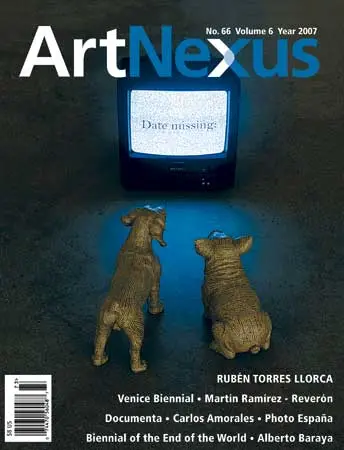
Rubén Torres Llorca (Havana, 1957) belongs to a key group of Cuban artists who, since the Volume I show, fostered a significant turn in their country’s art.
The particular relationship proposed in the presentation of his objects, the assemblage of his sculptures, confronts the viewer with elements that are familiar but are presented in such a way as to promote a complex dialog between viewer and object. Thus his intention is to create a space capable of driving viewers to talk about some aspect of their reality. A reality Torres Llorca has previously studied in order to reflect them and achieve a connection between his public and his works. Looking at his works implies acknowledging an interest in man’s relationship with his social context, seen from the perspective of both the public and the private.
His use of materials reinforces this intention. Their origin is diverse and they go from natural elements such as wood or clay to found objects deployed to articulate complex collages in which the use of language is also operative. Through the superposition of words and images, we are confronted with contradictions and inquiries that, in the end, are for the viewer to disentangle. As the artist has said, his work moves in the direction of having “[…] my objects serve as a catalyst for the individual’s problems. I want for the confrontation with the work of art to be an emotional event for them.” *
*Ruben Torres Llorca. Historias de amor y de muerte. Ninart Culture Center, Mexico.
IVONNE PINI
*Ruben Torres Llorca. Historias de amor y de muerte. Ninart Culture Center, Mexico.
IVONNE PINI
Issue Number: 66
Arte in Colombia: #112
Period: Sep 2007 - Nov 2007
You have 4 free articles remaining. Sign up for unlimited access.