Jul 1997 - Sep 1997
artnexus #25
Arte in Colombia #71
As it happens each time a military regime comes into power, the artists who introduce testimonials in their work must find ingenious ways to camouflage them. Eugenio Dittborn (Chile, b.1943) is a clear example of an artist who, living inside a dictatorship, was forced to rethink the resources of his language in order to continue to express himself in a repressive world.
With his Pinturas Aeropostales (Airmail Paintings), of the eighties, he constructed images from cut-out newspaper photographs, old magazines, and other sources, in an order to appropriate for himself an inventory of anonymous persons associated with lost memories. His purpose was to extract these individuals from a nebulous past and bring them abruptly to the present. The inventory he proposed. was similar to that created by the state to control its citizens by clarifying them. This type of information also served to declare them missing. The prints of those who were there remain, but they can also disappear in an authoritarian society that can dispose of the individual at any whim, to the point of stripping him of his identity and reducing him to namelessness.
After the dictatorship, Dittborn questioned the loss of memory that the authoritarian state attempted. to propagate.
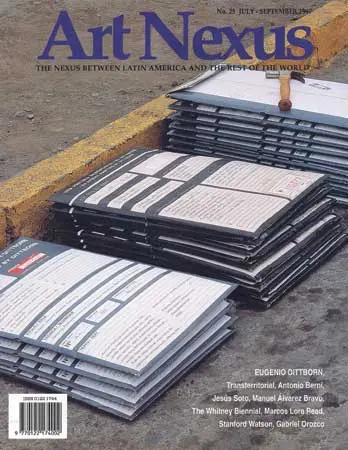
He also called attention to that other type of amnesia projected unto the process of returning civil institutions to normality as if nothing had happened; as if what happened the day before was already past history, susceptible of becoming involved in a narrative with little relevance to the present. Our cover features three Pinturas Aeropostales inside their envelopes in a street of Santiago, Chile: Cenizas líquidas (Liquid Ashes), La VI Historia del Rostro (The Sixth History of the Face), and Viaja (Travel). They are shown here three months before they were to be exhibited at the Institute of Contemporary Art, London, after returning from exhibitions held in Kassel, Boston, and Rome between May and November of 1992.
In their act of traveling, Dittborn's Pinturas Aeropostales allow a multiplicity of associations and enclose in his words, a venomous powder hidden between their folds. Could they perhaps contain canceled letters from the sender to the addressee to poison him in a present that is about to come? (See text by Victor Zamudio-Taylor).
IVONNE PINI
Issue Number: 25
Arte in Colombia: #71
Period: Jul 1997 - Sep 1997
You have 4 free articles remaining. Sign up for unlimited access.