Dec 2018 - Feb 2019
artnexus #111
Arte in Colombia #157
Despite the diversity of approaches that the work of Teresa Serrano (Mexico City, 1936) presents us with, there is in it a tendency to focus on gender perspectives and discourses from a feminist standpoint, engaging such major matters as violence, subjectivity, and power, and foregrounding issues of particular relevance for contemporary society, like migration, isolation, language, and others. In Serrano’s proposals, ethics and aesthetics intertwine to produce a body of work based on her own experience as a woman.
One of the most salient characteristics of Serrano’s art, in consequence, is a sustained commitment to highlighting the situation of women in today’s society, the latent male supremacy that continues to operate not only in her country, but in many other spaces, emphasizing the discriminations that take place in the realm of work, in the family, and in social life in general.
To project her proposals, Serrano deploys techniques ranging from painting to sculpture, photography, video, performance, and installation. An abiding interest in film drove to use elements of cinematographic language in her videos, and through such technical versatility, she shows that her decision to deploy a given resource is based on what she considers most appropriate for an artistic production packed with metaphorical associations.
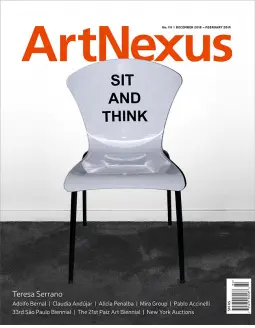
Serrano’s ironic handling of language is intended to bring the audience into the game of interpretation, using suggestive words that confront us with issues like the power of language. The work on our cover, Sit and Think, proposes a thinking body similar to the one posited by Bruce Nauman, a key figure for Teresa Serrano, when he wondered about what it is that an artist does: “If you see yourself as an artist and you function in a studio (…) you sit in a chair or pace around. And then the question goes back to what is art? And art is what an artist does, just sitting around in his studio.” *
* Bruce Nauman text quoted by Marian de Abiega Forán in “El lenguaje me da casa”, Teresa Serrano catalog. A retrospective at the Museo de Puebla, Puebla, 2017.
IVONNE PINI
* Bruce Nauman text quoted by Marian de Abiega Forán in “El lenguaje me da casa”, Teresa Serrano catalog. A retrospective at the Museo de Puebla, Puebla, 2017.
IVONNE PINI
Issue Number: 111
Arte in Colombia: #157
Period: Dec 2018 - Feb 2019
You have 4 free articles remaining. Sign up for unlimited access.