Sep 2017 - Nov 2017
artnexus #106
Arte in Colombia #152
Already in her early sculptures, Frida Baranek (Río de Janeiro, 1961), known as a member of the “1980s Generation”, showed an interest in exploring two aspects that have remained central to her work: her three-dimensional structures’ relationship with space, and the diversity of the materials. Ever since Lygia Clark’s radical practices, along with those by other Brazilian artists who abandoned the plane in order to experiment with space and with the body, new lines of inquiry have remained open in the arts, and Baranek did not turn her back to them.
In her large-format sculptures, based on elements that refer to resources frequently used in industrial processes, Baranek demonstrates a deep knowledge of her materials. Wire, wood, stone, iron, plastic, copper, leather, and aluminum are some of the raw materials she combines in order to generate relationships that result in complex compositions. Such notable mastery of the resources employed is the fruit of an intuitive reaction; it is the materials that grab Baranek’s attention in the first place and prompt her to work with them. The variety of the elements in use makes it possible for Baranek to create an organic whole, and the power of her sculptures is a product of her ability to assimilate and integrate such disparate resources.
Baranek’s works also surprise us with their construction and assembly processes. In that connection, the artist explains that her works are conceived like the project for a house. Before building it one must plan it structurally and establish where each piece will fit. “My works are made in stages, but they don’t necessarily end up being exactly as planned. There are times when a ‘mistake’ produces interesting results.” *
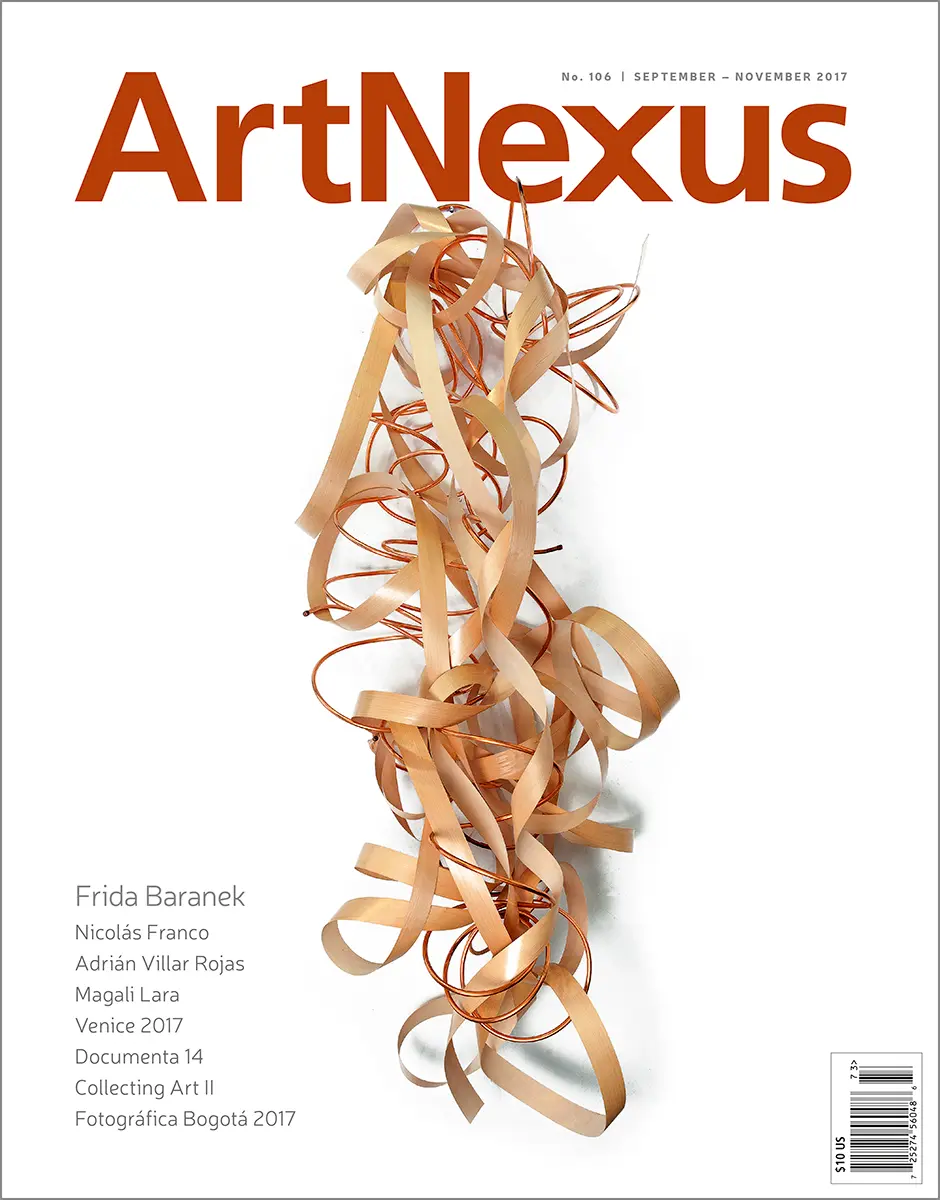
Baranek explores the tension and the contradiction that exists between industrial materials and those taken from nature, as illustrated by the work on our cover. In Relações de Incerteza III (Relationships of uncertainty III), she examines sensations of strength and vulnerability, subverting the common perception of materials used in industrial processes and experimenting with the existing dichotomy between weight/levity.
* O Casarão Jornal de Comunicacão Social da UFF, Río de Janeiro, 11/25/2013.
IVONNE PINI
* O Casarão Jornal de Comunicacão Social da UFF, Río de Janeiro, 11/25/2013.
IVONNE PINI
Issue Number: 106
Arte in Colombia: #152
Period: Sep 2017 - Nov 2017
You have 4 free articles remaining. Sign up for unlimited access.