Mar 2017 - May 2017
artnexus #104
Arte in Colombia #150
Horacio Zabala (Buenos Aires, 1943) is an architect by training and an artist by profession, and a prolific author both in the theoretical and the artistic fields. A member of Center for Art and Experimentation (CayC, in its Spanish acronym) and Group of 13 in his early Buenos Aires years, Zabala moved to Europe in 1976 and lived in different countries. He returned to his native city in 1998, and has lived and worked there continuously since then.
His work as a theoretician includes a large number of publications, including El arte o el mundo por segunda vez (Art, or The World For a Second Time); Conversaciones (Conversations), coauthored with Luis Felipe Noé; Vademécum para artistas. Observaciones sobre el arte contemporáneo (A Vade Mecum for Artists: Observations on Contemporary Art); and Marcel Duchamp y los restos del readymade (Marcel Duchamp and the Remains of the Readymade), which emphasizes the importance of Duchamp’s ability to say more with less.
As an artist, Zabala has experimented since very early in his career with heterogeneous media and materials, producing proposals that, as he puts it, “pose obstacles, irreducible remainders, or hidden dimensions,” while cashiering all homogenization and conformism. Thus his desire “to make what is seen susceptible of being thought.”
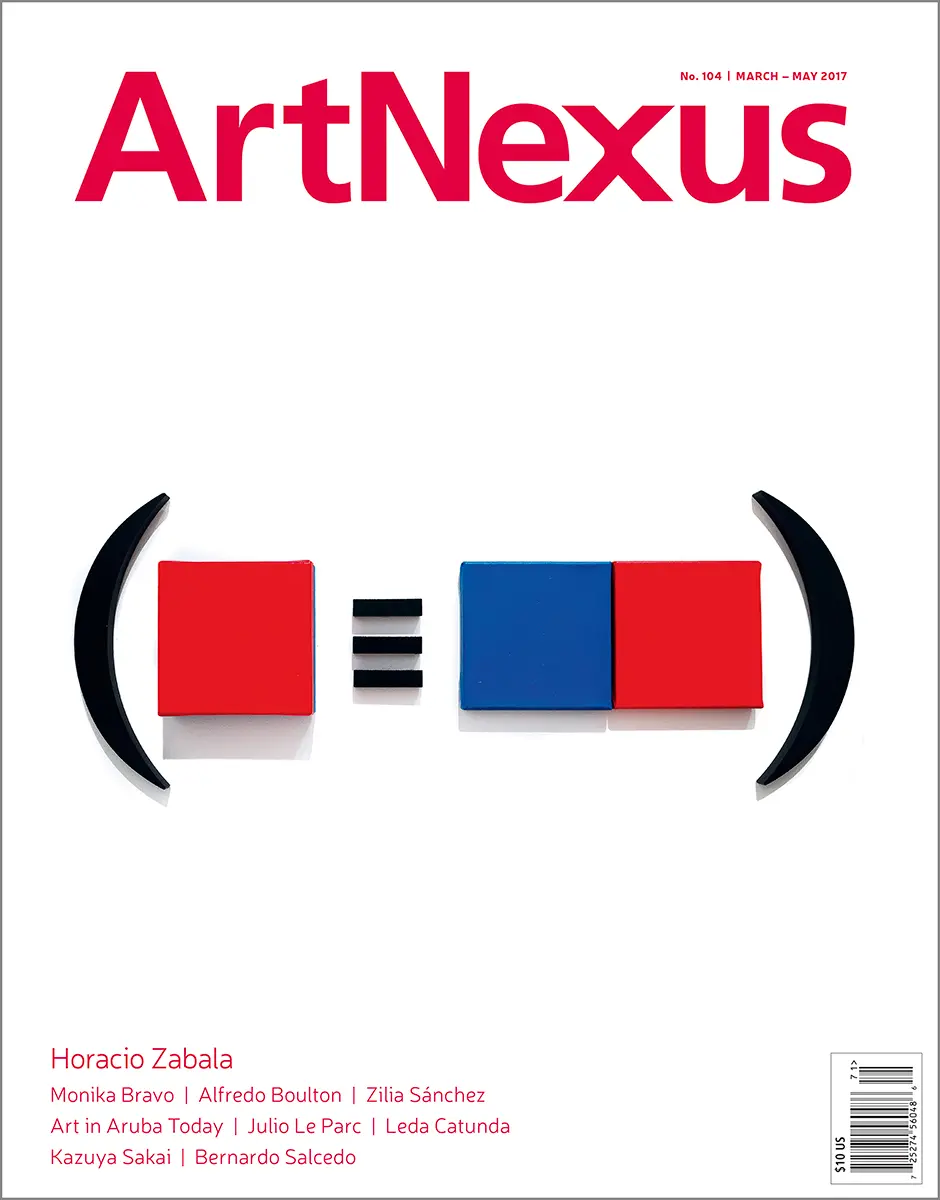
In the series of works that comprise his Hipótesis (Hypotheses), one of which is on this issue’s cover, Zabala presents us with a variety of monochrome shapes that interrelate on the basis of mathematical symbols or punctuation marks. It is as if he intended those symbols to have us confront pure forms, removed from all real-world perceptions. These hypotheses gradually incorporate elements that build what seems like equations but are in reality mere simulacra of rationality that add, subtract, and divide impossible elements.
IVONNE PINI
IVONNE PINI
Issue Number: 104
Arte in Colombia: #150
Period: Mar 2017 - May 2017
You have 4 free articles remaining. Sign up for unlimited access.